
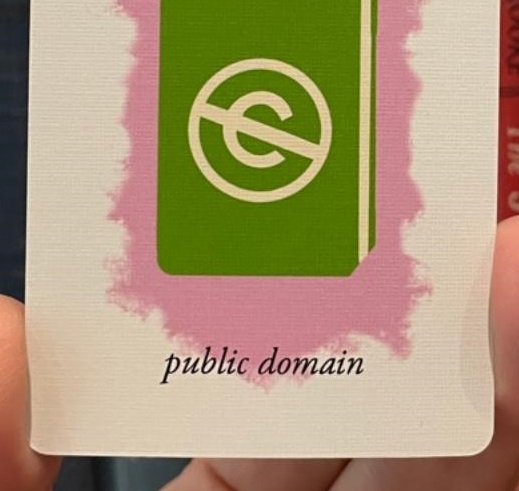
 Just what is the ‘public domain’ and why do you need to know about it? It’s appeal can be summed up in just two words: it’s FREE! The second card we’ve drawn in our ongoing #ReadSomething series is public domain, so let’s tell you a little bit about what that is, and how the public domain can enrich your life.
 Simply put, the term ‘public domain’ refers to creative works that are not protected by copyright, and are thus free for all to use, copy and adapt. This includes works given away by their creators, but also works whose copyright protection has lapsed. For decades, lengthening copyright terms in the U.S. had prevented new works for entering the public domain. Since 2019, every January on Public Domain Day (or as some still refer to it, New Year’s Day), a whole year’s worth of works suddenly become yours, mine, and everyone’s. It isn’t hard to understand why this is a day that librarians love. This month, works have entered the public domain that were originally published in 1925, which just happens to be one of the all-time greatest years for books – a year that blew up literature in ways we’re still catching up with today.


That was the year of such remarkably original landmarks as Virginia Woolf’s modernist masterpiece Mrs. Dalloway, Franz Kafka’s epitome of 20th Century angst and futility The Trial, or Gertrude Stein’s influential pre-post-modernist epic The Making of Americans. 1925 also saw the publication of In Our Time, the debut story collection of Stein’s then unknown acolyte, Ernest Hemingway. The Harlem Renaissance was in full swing, as witnessed in Alain Locke’s epochal 1925 anthology The New Negro, which highlighted the works of Langston Hughes, Zora Neale Hurston, Claude McKay, Jean Toomer and others. Major novels such as Dreiser’s An American Tragedy or John Dos Passos’ Manhattan Transfer were calling out the American Dream, and none so famously as F. Scott Fitzgerald’s The Great Gatsby, the public domain release of which has made some folks downright giddy, including the cast of NPR’s Planet Money podcast, who decided to read the whole thing aloud.
 That’s just the tip of a very large iceberg of books, movies and musical compositions that have just become our communal property, to say nothing of the roughly ninety-bazillion works published before 1925, also in the public domain. Where can you find out more about these public domain works? There’s the delightful Public Domain Review, a free online publication dedicated to the exploration of curious and compelling works in the commons. Also, The Online Books Page handily indexes millions of books available from myriad sites such as Project Gutenberg, Wikimedia Commons, The Hathitrust Digital Library, and The Internet Archive. So go forth and explore your new domains: wonderful adventures await!
~ Posted by David W.
Leave a Comment