
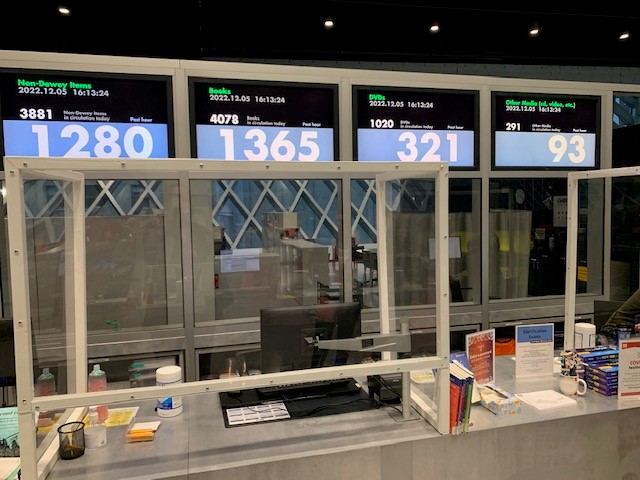

One of the many reasons to visit the Central Library in downtown Seattle is a digital art installation located on Level 5 in the Mixing Chamber. If you take the neon-yellow escalator up from Level 3, and walk to the Quick Information Center reference desk, you can’t miss it: Above and behind the desk, six LCD screens blink and change as colorful numbers and text float across them, conveying real-time and completely anonymous checkout information from all 27 Library locations.

Titled “Making the Invisible Visible,” this artwork was created over a two-year period by artist and digital media professor George Legrady and installed in the Central Library in 2005, one year after it opened. Throughout the day, four electronically animated visualizations float across the screens. Stay for the whole show, which lasts several minutes, and you’ll see running totals of checkout information, floating titles of recent checkouts, titles by Dewey classifications and a colorful “Keyword Map Attack.”

Since the Library opened, Legrady’s installation has mesmerized visitors and staff alike with its representation of, as Legrady put it, a “real-time picture of what the community is thinking.”
A gold mine of historic checkout data
The installation was innovative for its time, but in recent years it’s taken on a key additional function. Starting in 2017, the Legrady piece made it possible for the Library to not only start gathering all current checkout data in a comprehensive way, but also to gather and publish past checkout data from the time the art installation opened.
Data librarian David Christensen and systems analyst Nathan Cosgray recently shared the story. They were both involved with the effort, which began partly in response to the City of Seattle’s Open Data Initiative. The Open Data Initiative directed City departments to make their data “open by preference” to promote transparency, public/private collaboration and civic problem-solving.
“The timing was really convenient,” Christensen remembers, “because the Library was already in the process of setting up a data warehouse at the same time that the Open Data Initiative at the City level was getting off the ground.”
Prior to 2017, the Library was able to produce snapshots of Library usage but didn’t collect comprehensive checkout data in a way that was useful for understanding trends. This was in part due to privacy concerns – patron confidentiality is a bedrock principle for the Library and essential to intellectual freedom – and in part because the costs had been prohibitive.

“It’s like Moore’s law,” says Cosgray, “with computers getting exponentially more powerful while also becoming cheaper. We had gotten to the point where it was cheap enough and easy enough to create a large database to hold all of this information.”
At some point in the process, the Library’s team realized that Legrady’s installation – which had now collected checkout data for 12 years – was a gold mine of historic checkout data already scrubbed of patron information.
“The ability to track trends not just going forward but using past data was invaluable,” says Cosgray, who did the legwork on figuring out the solution. To this day, the Legrady feed populates the City’s open data portal.
Data scientist and literary scholar Melanie Walsh recently highlighted the story in an article she published on PublicBooks.org, “Where Is All the Book Data.” The article explored the difficulty in obtaining publicly available book data and lauded The Seattle Public Library’s participation in Seattle’s open data portal as a model.
The Seattle Public Library, she said, “is one of the few libraries in the country that releases anonymized book checkout data online, enabling anyone to download it from the internet for free.”
Why does publicly accessible data on books matter?
Data scholar Melanie Walsh points out that data on books can help us better understand our culture by seeing what communities are seeking out to read, which helps us invest our resources to meet the needs of those communities. A striking example is the surge of demand for books on racial justice and Black history in the wake of the 2020 protests.
Another example at the Library is how we used checkout data to build the case for eliminating daily overdue fines by showing that fines disproportionately affected lower-opportunity areas of the city. Now, almost three years after the Library implemented this change, this data is helping us understand the impact and benefits of a fine-free system.

Other organizations are making interesting use of the Library’s publicly shared data. In 2019 the site Pudding Cool used the data released to the City of Seattle to create a “hipster reading list” of books that hadn’t been checked out in over a decade. The site Kaggle extracted Library checkout data as a training tool for budding data scientists. And earlier this year, the Seattle Times created fascinating visualizations of Seattle’s pandemic reading (spoiler alert: “The Vanishing Half” by Brit Bennett was the city’s most popular Library pandemic read).
Want to explore the stories that Library data tells? You can access the Library’s publicly released data at Seattle’s open data portal at open.seattle.gov.
Note: One of the six screens in the Legrady installation – the screen second to the left – is not currently functioning. Hopefully it will be up and running again soon.
P.S.: Speaking of data wizardry, the Library just said goodbye and thank-you to Nathan Cosgray, as he moves on to the City of Seattle’s IT department. Thank you, Nathan, for your amazing work on important data efforts at the Library that are too numerous to mention. You will be missed!
– Elisa M., Communications
Leave a Comment