
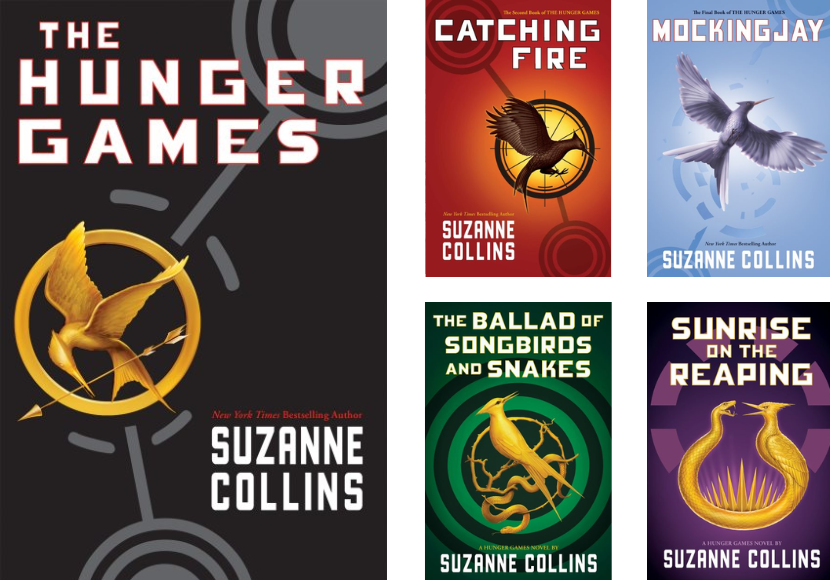
If you talk to me for more than a few minutes, my passion for Suzanne Collins’ Hunger Games series will undoubtedly come up. I’ve read the books at least six times each, have had genuine arguments about whether I’m allowed to name my children after the characters, made custom iron-on attire for movie premieres on multiple occasions, and could (and have) spent hours debating the casting decisions for the movies (mostly perfect, but did no one else audition for Peeta? Josh did the best he could with what he was given but…I digress). So, when I saw this year’s Book Bingo categories, it was clear that this was my time to shine: these books fit nearly every category on the board, and I’m here to share how you can achieve Bingo or work your way towards a blackout by reading the five titles in this magnificent series.

A quick overview for the uninitiated: The Hunger Games is a YA dystopia set in a near-future United States after a rebellion in which the all-powerful Capitol crushed the surrounding 12 districts. As punishment, every year, each district has to send two teenagers to fight to the death in a televised production in which one will be crowned Victor and the others will suffer at the hands of other children. The first book is the 74th Hunger Games and stars Katniss, a poor girl from District 12 (the coal mining district in what’s now Appalachia), whose 12-year-old sister Prim is chosen as the female tribute from their District. Katniss defies all precedent and volunteers to take her sister’s place, alongside a boy named Peeta who has loved her from afar since they were young children. Told from Katniss’s perspective, we see the desperation, cruelty, and inhumanity of the Hunger Games as she’s thrust into fighting for her life. As the books in the original trilogy (Catching Fire and Mockingjay) go on, the growing rebellion in the Districts increasingly takes center stage with Katniss playing a center role.
In the last few years, Collins has gifted us with two prequels as well: The Ballad of Songbirds and Snakes, set in the 10th Games and told from the perspective of the man who eventually becomes the evil President Snow and the first District 12 Victor, who has been forgotten (or erased?) in Katniss’s time, and Sunrise on the Reaping, which came out in March and tells the story of Katniss and Peeta’s mentor Haymitch, the Victor from District 12 in the 50th Games, before he succumbs to alcoholism.
Grief: Setting aside the fact that I don’t think I’ve ever cried as hard from a book as I did from reading Sunrise on the Reaping, these books offer varied and nuanced portrayals of grief. Because they focus on a literal fight to the death as well as the desperation of those under the thumb of a fascist leader, every character has suffered extreme loss. Collins depicts characters experiencing a wide range of natural responses to grief and trauma, including substance use, depression, and rage.
Censorship: Censorship and propaganda are a central theme of these books, made increasingly more obvious as the series goes on. Because the Games are televised, the Capitol controls the narrative surrounding the tributes, editing as they see fit. In later books, readers learn more about the extent to which the Capitol has engaged in censorship to squash growing rebellion in the Districts and keep them from mass mobilization.
Found Family: Sometimes nothing forms stronger bonds than shared trauma, and the relationships that develop between the characters of these books is proof. Katniss and Haymitch form a sort of parent-child relationship throughout the series, made even more poignant when you learn about Haymitch’s background in Sunrise on the Reaping. The loyalty, trust, and camaraderie that form between allies in the Games are also reminiscent of sibling relationships, especially Katniss’s view of sweet Rue in book one, who instantly reminds her of her sister Prim.
Resistance: Resistance is basically the theme of these books, as the origins of the Hunger Games arose from a quashed rebellion and, generations later, Katniss becomes the unexpected face for the next rebellion. One of the things I love most about re-reading these books and the new prequel additions is how Collins shows the many times District folks (and a select few Capitol class traitors) attempt to push back against tyranny. It’s clear that revolution takes time and the situations depicted are such great examples of how organized resistance can grow into success.
Disability: Both physical disabilities and disability from mental illness and trauma are prominent in the series, most clearly starting in Catching Fire. After Peeta loses his leg in the first Games, his prosthetic limb features in the second book, sometimes requiring additional support as he’s thrust back into the arena.
Monsters: If you’ve read any of the books or seen any of the movies, you won’t be surprised to see this category represented here. One of the most sinister elements of Capitol aggression are the “muttations” or “mutts” that they create and unleash on the tributes in the games, and the rebels later. These are typically animals genetically altered to be particularly terrifying or targeted to their victims, including vicious dogs with the eyes of previously murdered children, birds that echo with the screams of the tributes’ loved ones, and even typically harmless animals that are unexpectedly deadly (looking at you, squirrels and flamingos). Like Katniss and Peeta, you might find yourself haunted by these monsters in your dreams.
Dystopia: This is basically the overarching genre of the books!
Great Escapes: This category can be read in a number of ways, several of which apply to the Hunger Games! If you want to escape into an immersive world, made real by songs, smells, tastes, and place-based details, these books can absolutely take you there. Alternatively, you can marvel at the countless times Katniss manages to escape from near-death catastrophes.
Hope: I know these books can seem really dark and of course, the depictions of trauma and death, the all-too-plausible descent into full-scale tyranny, and especially the death of children made into entertainment are anything but cheery. At the core, though, much like Katniss coming across a tender boy, a loaf of bread, and a single dandelion when she’s on the brink of starvation, Collins centers hope as the solution to darkness. Having just finished my annual reread, I’m holding on to the epilogue of Mockingjay as my beacon of hope.
Intergenerational Friendship: I can’t believe I’ve made it this far without shouting out my number one favorite character, Mags. The elderly Victor and mentor from District 4 supported a number of the main characters (I think I screamed when she showed up in Sunrise) and created a sense of safety even in the chaos is a friend to many and is an example of the power of intergenerational friendship. Similar to the “found family” category, the relationships between mentors and tributes and between Katniss and her stylist Cinna show how older folks can form strong friendships with those in their youth.
~posted by Jane S.
For more ideas for books to meet your Summer Book Bingo challenge, follow our Shelf Talk BookBingoNW2025 series or check the hashtag #BookBingoNW2025 on social media. Book Bingo is presented in partnership with Seattle Arts & Lectures and the King County Library System.
Leave a Comment