
It’s an open secret that Seattle’s summer is the sunny antithesis of our rainy reputation. Talked about less is the amazing fruit that appears in farmer’s markets, co-ops, and along random sidewalks during the summer months. While there’s probably nothing better than eating a perfectly ripe fruit raw and unadorned, eventually, one wants pie. Or cake. Or to save as much of summer as possible in jars for winter. The following books are a good place to start dreaming and realizing delicious ways to fuss with fruit.
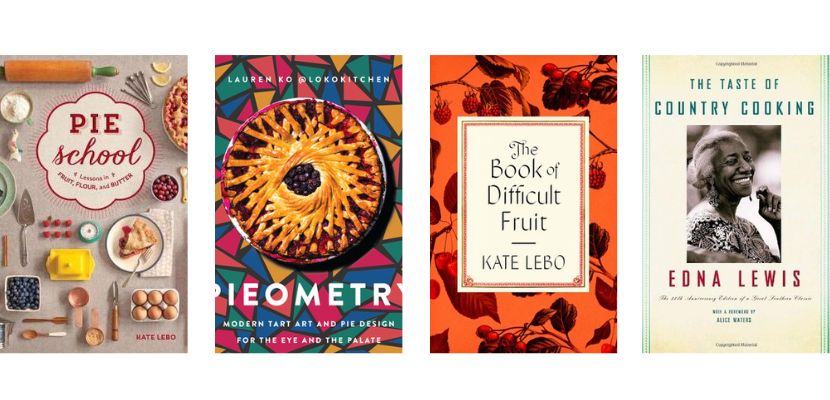
When I was a kid, blueberry pie was our definitive summer dessert. It always came out kind of runny, but worth the mild anxiety occasioned by making pie crust. Lauren Ko is a pie expert who lives in Seattle and whose pies are stunningly colorful, often using fruit like blueberries in the dough itself. Her book Pieometry even makes intricate pastry designs seem eminently doable. Kate Lebo’s Pie School is a wonderful source for advice and inspiration as it leads you by the hand through American pie traditions with a focus on fruit pies. Since Lebo has lived in Seattle, plums and blackberries, fruits that are especially easy to come by here, are especially well-represented. If you are more inclined to consider fruit and its place in our region and lives from a more reflective distance, Lebo’s The Book of Difficult Fruit is a gorgeous collection of memoiristic essays rooted in Washington State. Each essay meditates on a single fruit and concludes with a thoughtful and unusual recipe such as for persipan or umeboshi. Edna Lewis’s A Taste of Country Cooking is a rightfully famous history of seasonal foodways in the first half of the 20th century Virginia, which is obviously not local to Seattle. However, her recipes for blackberry cobbler and wine, plum tart, and strawberry preserves are very much at home here in the PNW.


If you find yourself bringing dessert to potlucks and parties, take a look at All-Time Favorite Sheet Cakes & Slab Pies by Bruce Weinstein and Mark Scarbrough. Their Midwestern Slab Pudding is a chill cousin to clafoutis that would be amazing with Washington cherries. The blueberry buckle, a soft cake spangled with berries, is a one-bowl wonder. Yossy Arefi’s Snacking Cakes offers smaller format fruity cakes like Berry Cream Cheese Cake and Almondy Plum Cake that are vibrant and quick. On the opposite end of the cake spectrum, you’ll find Cedric Grolet’s Fruit, a large, lemon-yellow book that details a rainbow of trompe l’oeil cakes that mimic their own fruit filling. (When I showed this book to a friend recently, she said, “Stop! This is killing me!” and then refused to give it back for half an hour.) Jason Schreiber’s Fruit Cake is somewhere in the middle of this cake-difficulty spectrum with fancy, yet approachable creations like Raspberry Tea Cake and Bourbon Peach Kugelhopf.


Baking is all well and good when we have cool weather. But when it is too hot to turn the oven on: Ice cream, sorbet, and paletas, please. Mexican Ice Cream by Fany Gerson gives a survey of Mexico’s ice cream culture with refreshing fruity recipes like Nieve de Sandia Picosita (Spicy watermelon sorbet). If you prefer popsicles or shaved ice, check out Gerson’s Paletas, which also has a chapter on fruit agua frescas. Kitty Travers’ La Grotta is pointedly concerned with fruit and has subtle, surprising flavors like raspberry and sage or tomato and white peach. If you’re a fan of wonk, Hello, My Name is Ice Cream provides readers with extensive reasoning behind ice cream formulations and the subsequent know-how to successfully experiment with a wide range of fruit. If you don’t have an ice cream maker, Easy No-churn Ice Cream by Oregon-based Heather Templeton includes possibilities like Huckleberry Swirl.


Some of us (me) would like to hoard (ahem, preserve) peak season fruit. Luckily, Camilla Wynne has two rad guides to help. Both books have colorful and charmingly retro design, and both books feature Wynne’s wry, cheerful, and explanatory-without-being-too-technical guidance. Jam Bake opens up vast possibilities of small-batch jam, fruit butter, and jelly recipes along with a variety of cake and pastry recipes to use them in. Wynne’s Nature’s Candy is a compendium of information on candying fruit (and vegetables. More than any book I’ve read this year, Nature’s Candy made me amped to attempt new things with syrup. For someone more inclined to make a plain jam without much elaboration, Liana Krissof’s Canning for a New Generation has simple, vetted recipes for preserves, fruity sauces, and chutneys. Marisa McClellan’s Preserving by the Pint is an excellent choice for those of us who live in small spaces but still want to put up the harvest.


I feel like I need to acknowledge the sheer amount of sweetness teetering in the paragraphs above. As palate cleansers, consider Pulp by Abra Berens and Ripe by Nigel Slater. While both books fully and compellingly cover fruit desserts, they broaden the field with fruit-filled savory appetizers, salads, and main courses. To paraphrase Pink Floyd, how can you have any cobbler if you don’t eat your apricot pilaf?
~posted by Kate K.