
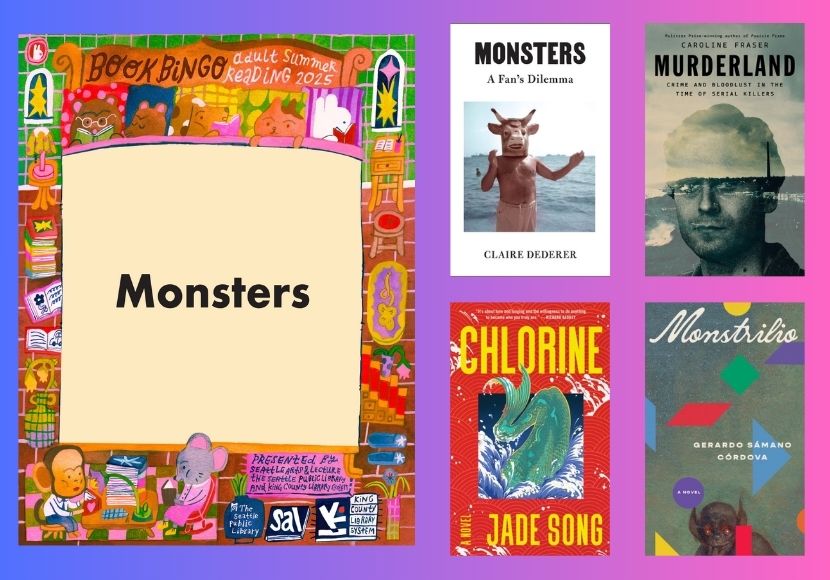
What makes a monster? Is it feral and visually arresting – a furry creature with glowing red eyes and razor-sharp teeth? Maybe your frame of reference is mythological: Medusa and her snakes, Scylla’s six hideous heads rising from the sea. Do you imagine the uncanny and unnatural – Frankenstein in his lab, foisting life onto his wretched creation? Or perhaps monstrosity is disturbingly human – a deviant among us capable of vile, calculated acts.
Monsters attract and repel because they transgress the boundaries of science, nature, humanity, and polite society. They force us to confront “the other” on a primal level. Below is a literary collection of beasts, real and imagined, to occupy your book bingo square.
Monsters: A Fan’s Dilemma by Claire Dederer
Dederer blends memoir and critique in this satisfying examination of what it means to love art made by problematic artists. How do we reconcile the appalling behavior of creators responsible for masterworks of art? She offers more questions than answers, but in doing so, invites us to grapple with monstrosity in art, in artists, and in ourselves. If you’re looking for concrete resolutions, look elsewhere. But if you are seeking heart, vulnerability, and lovely writing, Monsters delivers.
Murderland : Crime and Bloodlust in the Time of Serial Killers by Caroline Fraser
What potent alchemy of nature and nurture forges a serial killer? And why has the PNW proven such fertile ground for incubating these sadistic fiends? In Murderland, Pulitzer Prize winner and Seattle native, Caroline Fraser makes a disturbing and convincing case for an ecological cause – neurological damage inflicted by industrial pollution. Drawing on the “lead crime hypothesis,” Fraser persuasively correlates the location of smelters with the proliferation of violent criminals.
Queer as Folklore: The Hidden Queer History of Myths and Monsters by Sacha Coward
Historian Sacha Coward argues that folklore’s core themes, including exile, frustrated desire, and found family, are inextricably queer. Coward links queer experience to a range of mythic monsters, with mermaids as his entry point. He highlights drag performance, Han Christian Anderson’s sexuality, and the queer coding of Ursula in Disney’s The Little Mermaid. He also explores the LGBTQ+ community’s enduring connection to mermaids as powerful symbols of body liberation.
Chlorine is a body horror and modern fairy tale that regards monstrosity as a natural consequence of being abused and othered. Ren Yu, a young swimmer, is groomed by her coach and terrorized by her teammates. Her adolescence is raw and brutal, and she comes to see inhabiting her most monstrous self as a necessary act of self-alignment. Song addresses the Asian American experience of girlhood, Sapphic desire, body dysmorphia, disordered eating, and the toxicity of competitive sports. Think The Substance meets The Little Mermaid —a dark, visceral debut that demands a strong stomach.
Monstrilio by Gerardo Sámano Córdova
In this grief horror debut a couple is shattered by the death of their young son Santiago. Reeling from loss, his mother, Magos, cuts out a piece of his lung and secretly feeds it. The evolution of this organ into a sentient being impacts each character in dramatic ways. Told from multiple perspectives, this bizarre story portrays the transformation of a family that refuses to let go, the tension between savage instincts and societal expectations, and the cruelty of forcing a child to conform to unrealistic expectations.
For more monster books, check out this list! Happy reading!
For more ideas for books to meet your Summer Book Bingo challenge, follow our Shelf Talk BookBingoNW2025 series or check the hashtag #BookBingoNW2025 on social media. Book Bingo is presented in partnership with Seattle Arts & Lectures and the King County Library System.
~posted by Jennie D.