
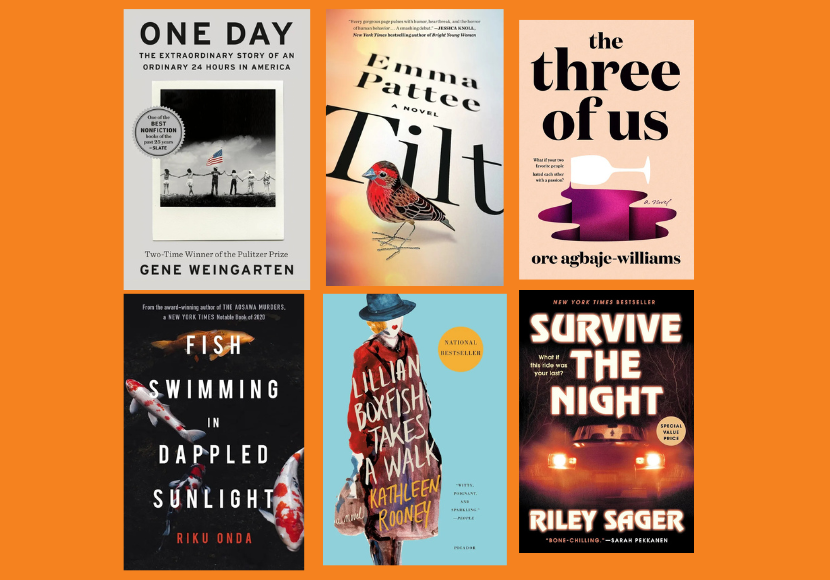
Stories with compressed timelines of 24 hours, with some flashbacks thrown in, take center stage here to showcase just how much one day can really make a difference.

“One Day: The Extraordinary Story of an Ordinary 24 Hours in America” by Gene Weingarten starts with the Pulitzer Prize-winning journalist choosing dates out of a hat. He lands on Sunday, Dec. 28, 1986. Sundays are typically a slow news day, but the author shows just how many life-altering events occurred on one seemingly innocuous day.
Stirring interviews bring a variety of stories to life that were revealed in six years of reporting the book: the murder of a young woman, two house fires, Reagan’s notes on the Iran-Contra affair, a failed marriage, a trans lawyer’s path to claiming her identity, and a heart transplant.
Narrative nonfiction that reads like fiction brings immediacy to people and events from a previous time; it’s almost like an invitation to a spectral seance where you can see, hear and feel the past.

“The point of living in the world is just to stay interested.” Kathleen Rooney’s novel “Lillian Boxfish Takes a Walk” introduces 85-year-old Lillian on New Year’s Eve in 1984, as she walks through New York City on foot. She recounts her days as an advertising writer for a well-reputed department store in the 1930s, as well as her bestselling poetry. Lillian’s voice crackles with wit and cutting observations, such as details of the sexism she experienced, including from a female work nemesis.
Throughout her walk and ruminations of the past, we see New York through the eyes of a woman who deeply loves the city and its messy peculiarities, even its potential dangers. Her zest for life and revelry in small interactions is infectious.
Inspired by the life of ad woman Margaret Fishback, the novel delivers an unforgettable character who carved a path for herself with sheer grit and gumption.

In the Pacific Northwest, we live on fault lines, and the big one could happen at any time. In Emma Pattee’s “Tilt,” the big one hits when Annie, nine months pregnant, is shopping for a crib in a Portland IKEA. Narrated to her unborn child, Bean, Annie shares the shattering moment that the world stops and she is buried alive beneath IKEA shelving.
After a formerly cranky IKEA employee becomes her savior and traveling companion, Annie goes on foot in search of her husband at a coffee shop downtown.
“Tilt” is by turns harrowing and hilarious, as we follow Annie with deepening investment and fear in a taut debut that powerfully pulls you into the hours after the world is torn apart.

Ore Agbaje-Williams’ “The Three of Us” is told from the vantages of two childhood friends and the husband stuck in the middle. “Temi and my husband, though, have always had something odd between them.” While Temi is the only character named, all three characters grew up in British Nigerian communities where their families’ lives often interconnect.
The wealth and comfort that the husband and wife have built together are disrupted by Temi’s influence and constant presence. Temi’s chaotic yet captivating energies and propensity to stir the pot bring tensions to a boil one night over wine and confidences shared. The book feels like a one-act play with a slow-burn payoff.

Charlie is ready to leave college and takes an ill-advised offer of a ride home to Ohio with a stranger in “Survive the Night” by Riley Sager. Josh Baxter seems nice enough when he shepherds Charlie into his car, but over the course of their hours together, things don’t add up, and Charlie finds herself in the fight of her life.
The recent murder of Charlie’s roommate, Maddy, and the threat of the Campus Killer striking again, form the backdrop of this propulsive thriller where we are hurtling down the highway alongside two characters whose reliability shifts as new information emerges. Sager knows how to ratchet up the tension and throws in plenty of surprises along the way.

How much do we know about those we are closest to, and how much can we trust our own memories of events? In an empty apartment in Tokyo, we watch Aki and Hiro do a postmortem on their relationship in “Fish Swimming in Dappled Sunlight” by Riku Onda, translated by Alison Watts.
On the eve of their last night living together, sitting on tatami mats with takeout, Aki and Hiro’s alternating perspectives share the complex nature of their connection and the mysterious death of their guide on a mountain hike that occurred in the past year. Twists and turns in the plot unfold and coalesce into seismic revelations in the final pages.