
“Happy” “New” “Year”?
Celebrating the passage of time freaks me out. I feel unsettled by the acknowledgement that humans assign numbers and meaning to our spins through space and time. And we don’t even all use the same calendar!
Time feels increasingly fake to me. I spent most of my college astronomy class either fighting off a panic attack or a nap. Time and space move in ways I can’t fully comprehend and that scares me. So why have I been spending so much time browsing the subject search, Space and Time – Fiction?
I’ve found an odd comfort in books that read like contemporary fiction, but include core topics such as outer space, wormholes, time loops, and multiverses. This subset of speculative fiction uses science fiction concepts to make sense of the complexities of the human experience in the “real” world. If you, too, feel unmoored in January, here are some recommendations to help you lean into the weirdness of it all.
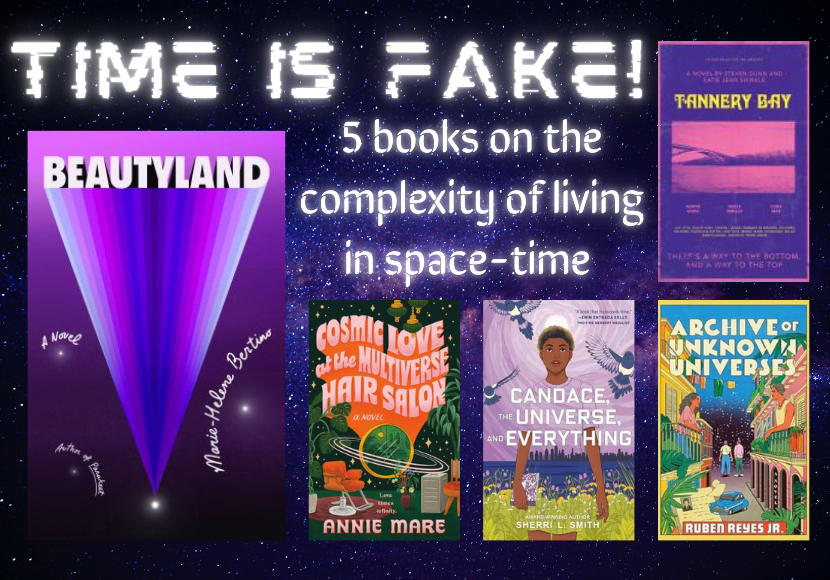
Beautyland by Marie-Helene Bertino spans the life of a woman, Adina, as she faxes observations on human behavior to her alien superiors millions of light years away. Bertino masterfully uses the speculative to unearth solitude, togetherness and all the cracks in between.
“There’s a reason it’s called alien-ated. Because I am an alien, I am alone … When you’re alone, you are in the right place to watch sadness approach like storm clouds over an open field…” (Beautyland, p 140)
I think about this book every day of my own earth life.
Candace, The Universe, and Everything by Sherri L. Smith, a middle grade novel with adult appeal, uses wormholes to dive into multigenerational friendships. After Candace discovers a wormhole in her locker, she connects in real-time with the women who used the same locker as girls. Together, the three of them set out to map wormholes and understand the world inside and out.
Archive of Unknown Universes by Ruban Reyes asks the question, “what if things were different?” Using a Defractor, a device that allows you to alternate universes, the characters in this beautiful novel apply that question to both interpersonal relationships and global paradigms, ultimately discovering that the two are inextricably linked. What if The FMLN succeeded in El Salvador? What if Rafael and Neto’s love persisted? What if things were different?
Tannery Bay, co-written by Steven Dunn and Katie Jean Shinkle, is a weird and wonderful romp through a dystopian time loop. The residents of Tannery Bay have been trapped in July for longer than anyone can remember. Only the Owners have any financial wealth, but the found family at the center of the novel use Black queer joy and art to reclaim power and break out of an oppressive time loop.
“We have to believe that what we’ve seen, heard, and experienced is true. We have to believe in each other’s experiences. And we figure out how to make the most of what we know without causing more harm.” (Cosmic Love at the Multiverse Hair Salon, p. 59)
In Cosmic Love at the Multiverse Hair Salon, Tressa Fay and Meryl fall in love through overlapping universes as they try to change the present through the past. Meryl disappeared in September. Tressa Fay is texting her in October, and Meryl is texting her back in May. The concept may hurt your head, but the love story will heal your heart. There is so much love in every universe and timeline!
These books may not be considered “realistic” fiction, but we need the speculative and the weird to make sense of our own unrealistic lives in this universe. I hope you find the space and time to enjoy these picks while you experience the uniquely human tradition of a “new” “year.”
~posted by McCall O.