
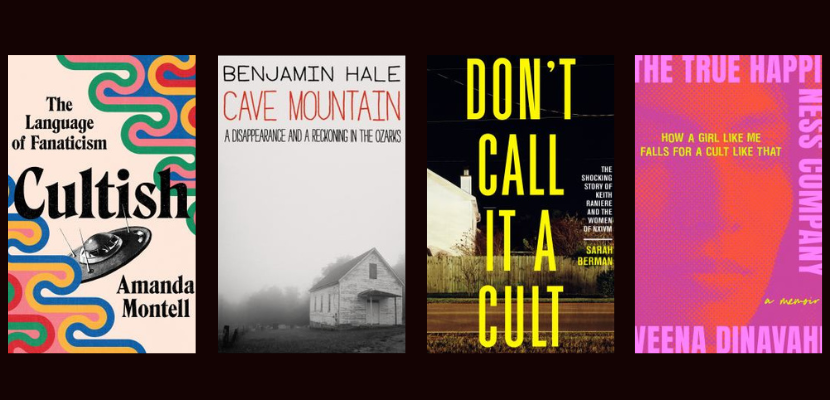
Cult stories seem to be having a bit of a moment in our cultural consciousness (go figure), usually the weirder the better. From the ancient Greek Mysteries to Charles Manson to Midsommar, humanity’s cultural landscape is littered with cults. They equally fascinate and repel, highlighting how our deepest longings to belong can so easily be twisted into something horrifying and inhumane. The following books explore this tension, from the initial spark of curiosity to the inevitable tragic aftermath.
Amanda Montell’s excellent cultural study, Cultish: The Language of Fanaticism, explores the language cults use to draw people in. Mixing journalism, personal history, interviews with former cult members, and anthropological analysis, Montell considers everything from Heaven’s Gate indoctrination methods to modern wellness influencers to the Peloton community to show the similarities in language and rhetoric used by each with the goal of helping readers “distinguish between benign and dangerous communities, and reduce the stigma that can further entrap people in cults” (Publisher’s Weekly).
In the true crime tradition of Under the Banner of Heaven and with an eye towards the story of place, Benjamin Hale’s Cave Mountain: A Disappearance and a Reckoning in the Ozarks (March 2026) digs into the disappearances of two young girls in the same Arkansas woods. One of the young girls, Hale’s cousin, was eventually found and her disappearance was linked to that of another young girl decades earlier, ultimately revealing “a dark and bizarre story of a cult, brainwashing, murder, and the apocalyptic visions of a teenage prophet” (Publisher).
In her debut book, Don’t Call it a Cult, investigative journalist Sarah Berman uses in-depth reporting and interviews with former members to detail the methods that built, enabled, and protected Keith Raniere and his personal development company, NXIVM, for years, even as it engaged in sex-trafficking, forced labor, and branding, among other abuses. Berman’s engrossing narrative also depicts NXIVM’s eventual downfall, the resulting investigation, and finally Raniere’s trial and conviction for a comprehensive look at a modern wellness cult.


No matter how well-researched and reported the story, true crime is always filtered through the eyes of the storyteller, who is always on the outside looking in. But in The True Happiness Company by Veena Dinavahi, Dinavahi recounts her absorption into the True Happiness cult as a teen and the conditions, both cultural and personal, that allowed it to occur with both the rawness of a survivor and the understanding earning a degree in psychology later gave her.
In her moving memoir When the World Didn’t End, screenwriter Guinevere Turner limits her perspective to that of her childhood self by using her childhood and adolescent diaries to tell the story of being raised within the Lyman Family cult, as well as what it was like learning to live in a world that she had been raised to believe was evil after her mother left the Family, as it was known, taking 11-year old Guinevere and her younger sister with her.
Daniella Mestyanek Young chronicles her childhood in the Brazilian commune of the religious cult Children of God as the daughter of high-ranking members in her memoir Uncultured, as well as her life after. Escaping the commune at 15, Young excelled in public school, graduated college as a valedictorian, and eventually joined the military as an intelligence officer, only to find herself in a place that felt all too familiar. Young’s determination to not just survive but also thrive shines through brilliantly.
In The World in Flames: A Black Boyhood in a White Supremacist Doomsday Cult, award winning author and creative writing professor Jerald Walker details his upbringing in the racist, segregated Church of God cult in the 1960s and 70s. Both of his parents joined willingly, taking comfort in the belief of being chosen for salvation after a lifetime of hardship that left them both blind and their family mired in poverty. When the promised End Time came and went, Walker was finally free to seek a future he never expected on his own terms.
In fiction, PNW local author Jess Walter brings cult fanaticism closer to home (and this decade) in his latest novel, So Far Gone. Alluding to the hope that no one is so far gone as to be irredeemable, a gruff recluse is forced to confront the world and family he left behind after the 2016 U.S. elections to search for his now missing daughter and rescue his grandchildren, with whom he has just been reunited, after they are kidnapped by the Christian Nationalist militia their father has joined.
If cults are so evil and full of heinous abuses, why do seemingly rational adults willingly join them? Hester Steel explores this question in her queer, cosmic horror debut novel The Faceless Thing We Adore. Hoping to escape her dead-end life, Aoife sets off for the sun-drenched beaches and blissful communal life promised on an intercepted postcard meant for her abusive boss. At the Farmstead commune, she finds the love, acceptance, and community she’s always longed for. But not all is well in this sunny paradise. Steel deftly mixes cult and eldritch horror to create a propulsive, page turning novel about what we’re willing to sacrifice to belong and what we do to survive.
~Posted by V.