
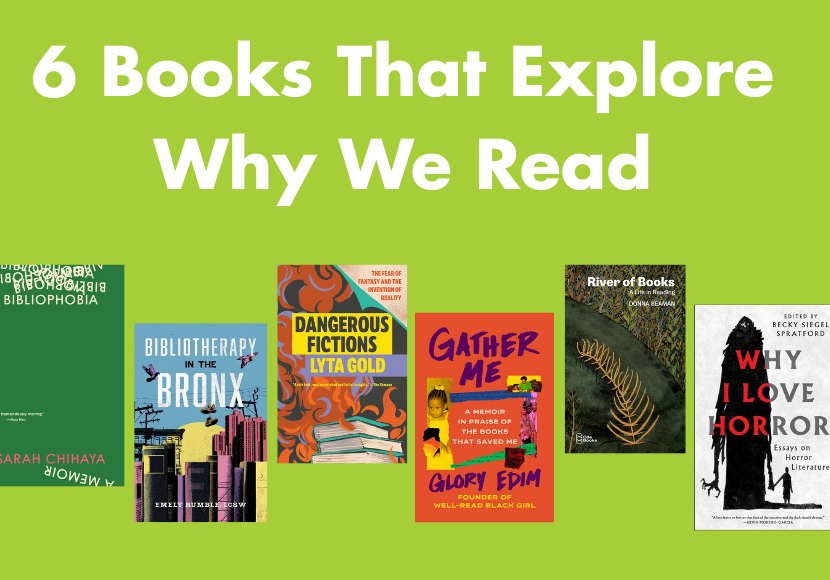
Many of us start the new year with a resolution to read more. We hear that it’s good for us, helps us unplug, opens our mind and gives us space to escape our daily stresses.
But what else does reading provide, and what are its perils? These recent memoirs and books about reading explore this question in different and expansive ways.

Donna Seaman is the editor-in-chief of the book and media review publication Booklist, but her path to a life of books was circuitous. In “River of Books,” Seaman shares her struggles in high school, her teenage substance use and how finding a specialized school in her small town in New York changed everything.
From an early age, though, she knew that reading was subversive, a protest and a perspective-enhancing act. “There is a voluptuousness to giving oneself over to language and all that it conjures, an erotic charge in communing with the thoughts and feelings of another.”
This memoir revels in the pleasures and discoveries possible in a life dedicated to the written word.

In “Gather Me: A Memoir in Praise of the Books That Saved Me,” Glory Edim, founder of the online reading group Well-Read Black Girl, shares how she discovered solace in books well before she created a community celebrating Black voices in literature.
While her early childhood was stable, after her parents divorced, that stability was ruptured by a domineering stepfather, as well as her father’s move back to Nigeria. “What I was truly interested in were stories of children who were in peril and somehow made it out.”
Reading provided Edim with visions of survival when the present felt hopeless and fraught, but it was the representation she found that helped her learn to not just survive but thrive.

In “Bibliotherapy in the Bronx,” social worker Emely Rumble shares how she uses books with her clients in their work to confront and overcome traumatic experiences.
Applying a decolonizing lens and centering “the voices and experiences of BIPOC (Black, Indigenous and people of color) and other marginalized communities,” Rumble uses literature to help young people and adults connect with their emotions and experiences in a cathartic and enlightening way. “As a therapist, I’ve witnessed the transformative power of poetry, which helps readers make meaningful connections between the symbolism in a poem and their most authentic thoughts, feelings, fears, and longings.”
Sharing examples of how reading has helped clients work through real problems invites an understanding of the potential of the nascent practice of bibliotherapy as a mode of understanding and deeper connection.

“Bibliophobia” by essayist and book critic Sarah Chiyaha explores the darker aspects of a reading life.
Chihaya explores the books that spoke to her and informed her desire to write, as well as the books that destroyed her. While books and reading can enrich a life, this memoir delves into the ways that reading can become obsessive and result in emotional highs and lows, exultation, but also anxiety. “The notion that certain books—you never know which ones!—can somehow overpower or enthrall their readers, such that we might never escape them.”
She shares her struggles with depression and suicidal ideation and how exploring these themes and personal stories in literature helped her wrestle with her own. Chihaya’s complex relationship with reading offers a counternarrative to its joys by delving into its sorrowful side.

Lyta Gold’s “Dangerous Fictions: The Fear of Fantasy and the Invention of Reality“ asks why our culture is so afraid of books and reading.
The fear of fiction or stories and what they can do is essentially, Gold says, the fear of other people. Gold’s chatty and sometimes snarky look at fiction and its uses offers a rich exploration of topics such as book bans, whether stories can inform or harm and whether stories truly create empathy.
Through lively examples in history and recent events in popular culture, this book makes learning about fears surrounding stories delightfully entertaining.

“Why I Love Horror: Essays on Horror Literature,” edited by librarian Becky Siegel Spratford, brings together the voices of horror authors.
Gabino Iglesias says, “I love horror because when the folks in the ivory towers said it was a lesser genre, horror didn’t care.” Each essay sings the praises of this often-misunderstood genre. Authors like Hailey Piper, Tananarive Due, Stephen Graham Jones and Victor LaValle share their gateway reads and why they continue to love what horror stories can do.
The Grady Hendrix piece on his father is worth the price of admission (seriously, it’s a chilling family portrait), and the overall chorus will make you see the complexity and beauty in horror and why people gravitate to stories that scare them.
By Misha Stone, Reader Services librarian
This column was originally published in the Seattle Times as part of our monthly column, and is reprinted here with permission.