
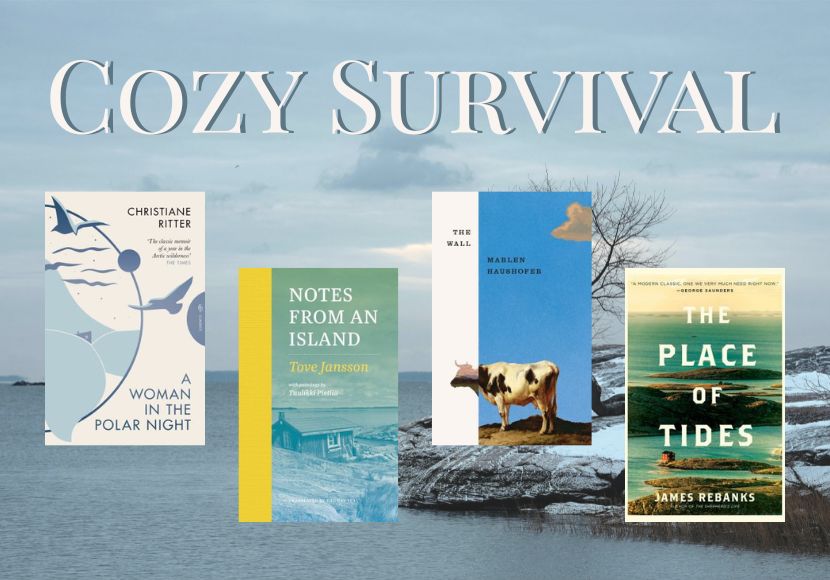
Lately, I’ve been running across books that instruct by example how to eke out survival while making a comfortable home. Cozy survival, if you will. In January, my apartment had a gas leak that caused a lapse in hot water and heating. Winter suddenly became very wintry. Luckily, I felt more prepared to weather the discomfort graciously after reading several books that center on cozy survival.
A subgenre that cropped up several times in my January reading is that of fiercely independent Scandinavian women living on islands, navigating the tension and crucial cooperation between the natural world and their human communities. Tove Jansson is the GOAT in this category. Her novel The Summer Book is a beautiful (and funny) portrait of a relationship between grandmother and child and the seasonal cycles that govern life on a tiny island off the coast of Finland.
For more grit blended with the romance of island life, and for any true Jansson fan, it is worth seeking out Jansson’s Notes from an Island that chronicles life on an even smaller, more outlying island. Published late in Jansson’s life in artistic collaboration with her partner of many decades, Tuulikki Pietilä, Notes also includes journal entries by their piratical friend Brunström. It’s a chronicle of building a cabin, storms, and the complex logistical demands of living on an isolated rock. Yet amongst all the DIY bustle, this is a book about the grandeur of the sky, the sea, and the passing of time tempered by the fun of scrounged supper parties with friends, kite flying, and freedom from the grind of mainland society.
Last year’s The Place of Tides by James Rebank offers a window into life on Norway’s Vega Islands, a UNESCO World Heritage Site. In a state of burnout with his work as a journalist and farmer, Rebank arranges to spend a summer on a tiny island with Anna Måsøy, an elder who devoted her life to the tradition of stewarding eider ducks. Together, along with help from a few residents of Vega, they set about organizing life for themselves and hundreds of mother ducks. Rebank begins with a hope that he’ll find a simple cure for his despair in noble isolation. Instead, he comes to terms with boredom and restlessness, finds his assumptions subverted at every turn, and reaches a correspondingly richer reconciliation with a complicated world.
Christiane Ritter’s A Woman in the Polar Night takes readers even farther north to Svalbard. This memoir chronicles a year spent in and around a tiny hunting outpost, and Ritter vacillates between awe at the frozen grandeur and good-natured disappointment at spartan living conditions that are so unlike her cozy expectations. A huge part of this book is about how one’s inner weather and the outer weather are interdependent, that a change of perspective can come from within our own minds as well as external forces. When not making a home in the arctic circle, Ritter was a painter who lived in Austria. Her book was first published in 1938. While a glorious piece of travel and nature-writing in itself, the context of social turmoil and imminent war surrounding its publication give even more weight to this book’s eloquent meditation on isolation and hope.
OK, stay with me. We’re now leaving the Norwegian Sea but keeping the connection to Austria and fears about the end of the civilization. The Wall, Marlen Haushofer’s 1963 speculative novel, imagines a highly unlikely scenario: Imagine going away for the weekend with friends to a little forest lodge in the Austrian Alps, staying home while the friends head out to the pub, then finding yourself suddenly sealed away from civilization by an invisible wall. As far as you can tell, everyone, human and otherwise, on the opposite side of the wall is dead. This is what happens to our nameless narrator, and so she sets about subsisting in the mysteriously spared patch of forest. While its premise explores the particular horror and guilty fantasy of imagining being the only human alive, what I loved most about The Wall was the narrator’s profound care for the animals she finds herself living with. Haushofer skirts easy answers and doesn’t shy away from tragedy, yet she balances these with moments of beauty, mundane practicalities of making do, and a depiction of desperation that manages to be expansive.
The worst of winter is past us this year. Every day we’re gaining whole minutes of light, and there are even stretches that don’t require coats. I am grateful to have hot water again, and I’m grateful for these books that help to put things in perspective, with enough suspense to temper the hygge a bit.
~Kate K.