
Black people throughout the diaspora have long preserved their dynamic cultures through African and African American oral traditions and poetry. Poets of the Black/African diaspora write passionately and often pull from many Black poetry forms and traditions to express collective and individual joy, survival, pain, and various facets of their lives.
The collections suggested here explore, celebrate and illuminate the vast, intricate lives and experiences of Black people of the Americas, the Caribbean, on the continent of Africa, and throughout the world.

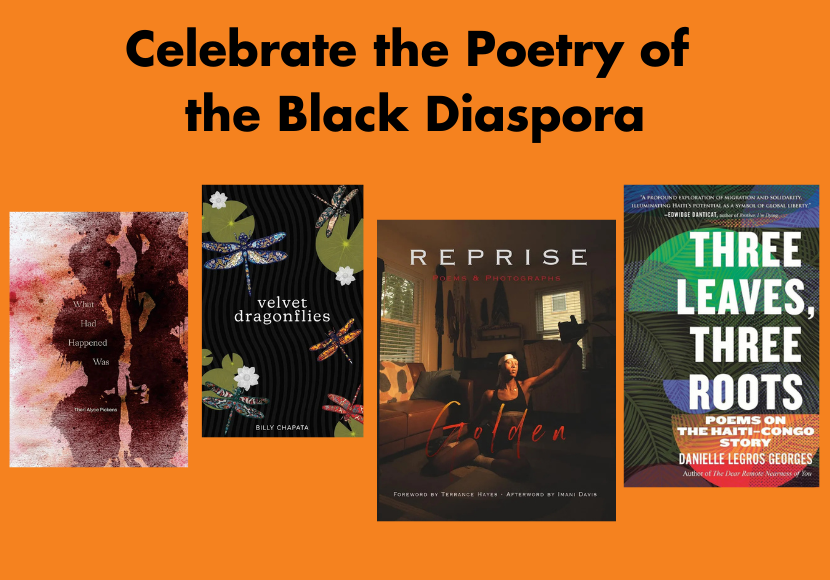
In “Reprise,” Golden, a Black American poet, photographer, installation artist and educator, creates a colorful, lyrical and piercing collection that is an unflinching look into the reality of navigating life as a Black trans person in the United States. They also examine what it means to survive and thrive despite the impacts of various systems of oppression. “Reprise” explores Blackness, trans identity, queerness, gender, the meaning of being an American, family, love and the pandemic.
In poems such as “& When They Come For Me (Reprise)” and “[XY]/[XX],” Golden uses repetition and creative use of form to further interrogate these themes. The pages are vibrant red, black, green and white, with stars and stripes that resemble the Pan-African/African American flag. Golden’s curated photography appears alongside many of their poems, further portraying the innate beauty and complexity of Black people, specifically Black trans people.

In her debut poetry collection “What Had Happened Was,“ Therí A. Pickens, Black American poet-scholar and professor at Bates College, seamlessly explores personal narrative, Black American life, systemic injustices, pop culture, history and chronic disability. Pickens’ collection is categorized in four sections: “This,” “That,” “Mind You,” “& The Third.” Many of her poems have a cadence reminiscent of writer and historian Paula Giddings’ “When and Where I Enter: The Impact of Black Women on Race and Sex in America.”
Pickens boldly grounds readers in time and place with poems like “On This Day” and “Corona Poem,” while poems such as “The Amateur Gardener Considers a Time of Death” illustrate the realities of living with chronic disabilities. Pickens also explores love, grief and the self with poems “my lover says (my mind)” and “On March 12, 2020, Breonna Taylor.”
In her titular poem, Pickens writes, “What had happened was I learned to love me later on: when no one was looking, I massaged a callus/mistaking it for muscle, cascading pressure, alternating misrecognition.”

“Three Leaves, Three Roots: Poems on the Haiti-Congo Story“ is a collection by Danielle Legros Georges, the late Haitian-born, Boston-based poet, writer, editor, translator and academic. She was also Boston’s second poet laureate. In “Three Leaves,” Legros Georges takes the reader on a journey of migration, postcolonialism, resistance and Black transnational collaborations in the Democratic Republic of Congo, Cuba and Haiti from the 1950s to the 1970s, while also exploring her own family history. Her parents were among the many Haitian educators who migrated to Congo in the wake of the country’s independence from Belgium.
In poems like “In Kinshasa” and “Trouble in Your Country,” readers get a sense of how Haitians and Congolese people navigated their lives as well as what was happening in Haiti at that time. In other poems, Legros Georges delves into Belgium’s brutal colonial violence and exploitation of Congolese people and how that impact is still felt there today.

“Velvet Dragonflies” by Billy Chapata, a Zimbabwean poet, author and creative based in Atlanta, is another collection to consider. Divided into five sections — “Viscose,” “Koigu,” “Damask,” “Charmeuse” and “Landing” — it explores self-love and love of others, and provides insightful ruminations that can inspire readers to try again or take another path when one does not seem possible.
Poems like “new scopes,” “flowers will grow from this” and “slow down” speak to change and growth, while “(better late than never),” and “remember:” are about learning to reconnect with self. Chapata also writes of healing and of the kinds of love we can hope for from others in “(love isn’t a game, neither is it a competition)” and “(energy you deserve).”
“Velvet Dragonflies” reads like a gentle conversation between friends, or a conversation we can have with ourselves to deepen our own understanding.
By Okunyi Bëhree, humanities librarian. This column was originally published in the Seattle Times as part of our monthly column, and is reprinted here with permission.