
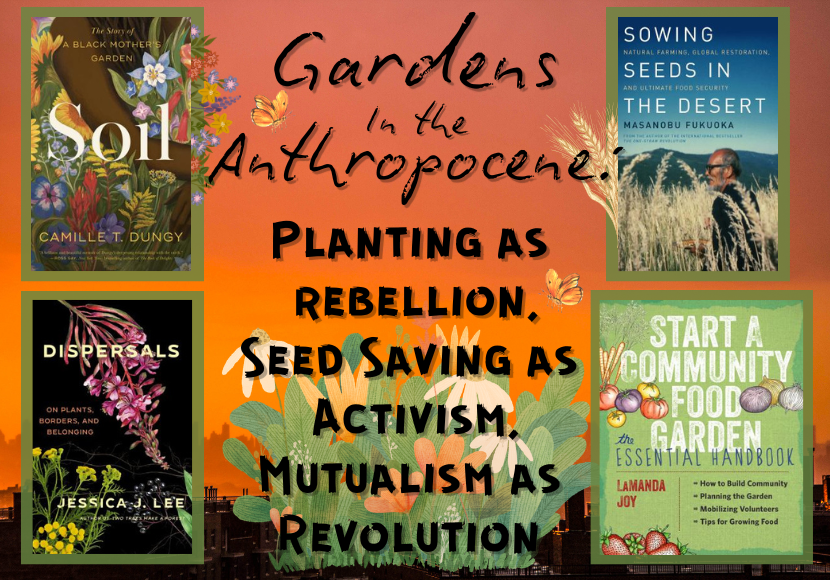
After another weird winter that gave us snow in March, Spring has officially begun: the Cherry Blossom cam at UW is live and the trees are in glorious bloom. In an era of compounding global climate crises, expanding food deserts, and catastrophic land and resource extraction in the race to build ever larger, more powerful data centers with the rise of AI, gardens can be sites of rebellion to extractive capitalism. Whether you have access to acreage, a backyard garden, containers on your doorstep, reclaimed land, or a P-Patch, the following books showcase how caring for a garden can be radical acts of resistance and rebellion, from seed saving for future generations to guerilla gardening to gardens as communities of planetary care.
Best known for his 1978 revolutionary no-till farming manifesto, The One Straw Revolution, Masanobu Fukuoka also published a follow-up, Sowing Seeds in the Desert, which detail his travels across the world helping others put his teachings from One Straw Revolution into practice, as well as the living philosophy of being part of nature as a human, not above or beyond it. Both books exemplify how and why to resist global farming capitalism that relies on resource extraction and land theft for its unsustainable harvest, little of which end up in the hands or mouths of those it purports to feed.
It’s no mere plot point that the thing the old desert women of George Miller’s Mad Max: Fury Road were willing to die for was seeds: they both represent and are the literal foundation for a new world. Just in Case, written by Megan Clendenan and illustrated by Brittany Cicchese and Seeds on Ice by Cary Fowler illuminate the Global Seed Vault project in Svalbard, Norway and why seeds are so important to our collective future amidst the incredible loss of biodiversity across the planet, corporate-controlled monoculture farming, and biotechnology’s GMOs. You can start your own seed saving practice with Dan Janson’s accessible Saving Seeds: A Home Gardener’s Guide to Preserving Plant Biodiversity, learn how to organize a community seed swap with Josie Jeffery’s Seedswap, and explore the history and necessity of setting up a community seed library with Seed Libraries and Other Means of Keeping Seeds in the Hands of the People by Cindy Conner. Visit High Point Library to see a community seed library in action, where library patrons can claim up to 5 packages of vegetable, herb, or flower seeds regardless of age per gardening season (Feb. – Oct.).

If saving seeds is a necessary act of activism to protect biodiversity, planting them can be outright rebellion. In her memoir, Soil: the Story of a Black Mother’s Garden, Camille T. Dungy recounts the 7 years she spent fighting for the right to diversify her garden in Fort Collins, CO – a predominantly white community with strict rules for what could and could not be planted in personal gardens. More than just a garden diary, Dungy uses her garden to speak about personal heritage, belonging, racism in post-2016 America, global warming, and urgent social and environmental justice issues. Jessica J. Lee likewise considers what it means to belong, for both humans and plants, across 14 essays on non-native species in Dispersals: On Plants, Borders, and Belonging. Tao Orion further challenges the deliniation between native and non-native plants in Beyond the War on Invasive Species, making the case that the label of “invasive” sets off a war in land management that ultimately contributes to ongoing climate change and habitat destruction and asks us instead to “look beyond the idealized notion of resotration, and to embrace nurturing practices that can create conditions in which all life can flourish” (publisher). Clare Follmann locates the problem with invasive species as a problem of capitalism in her book Scapegoat: What the Invasive Species Story Gets Wong, as the labels of “native” and “invasive” too frequently provide cover for political and corporate interests with devastating ecological consequences.
In his landmark 1977 essay The Unsettling of America, Wendell Berry writes “character and community — that is, culture in the broadest, richest sense — constitute, just as much as nature, the source of food. Neither nature nor people alone can produce human sustenance, but only the two together, culturally wedded.” Like Fukuoka and several of the authors noted here, Berry locates nature, more specifically the care and stewardship of it, as the ultimate source for healing both for us and for the planet. In Perennial Ceremony, Teresa Peterson guides you through seasonal realationships with the earth, demonstrating the kind of renewal of soul possible, sharing poems and recipies along the way. Whether you engage in a network of Guerrilla Gardening to transform land from being an economic commodity back into a community resource, or Start a Community Food Garden, caring for the land brings us back into connection with something greater than ourselves in ways that resist exploitave, profit-driven extraction and are sustainable, not just for us as individuals, but for our communities and for the earth we all call home. Imagine what the world could be like if every community had the ability to grow what it needed to thrive.
~Posted by V.