
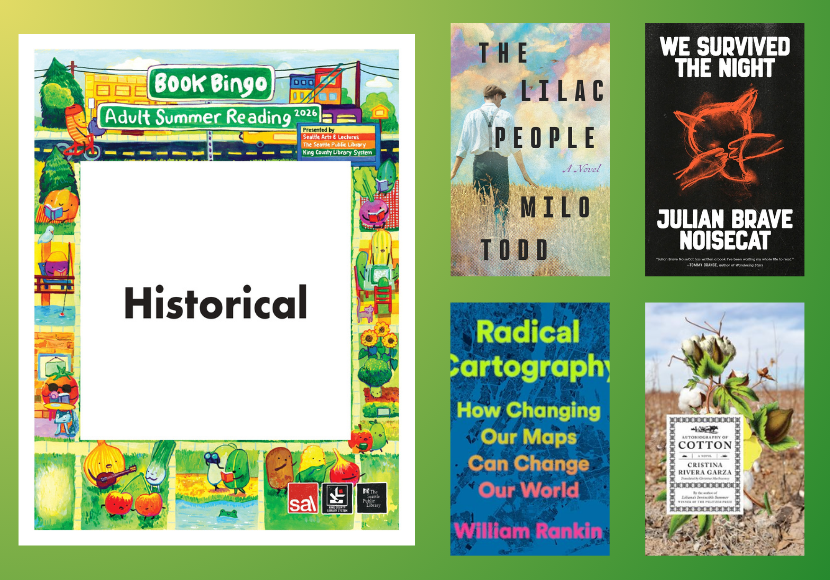
One of the goals of Book Bingo is to have as many entry points as possible for readers, and the “Historical” category is a great example. An alternate history speculative fiction? Check! A biography of a historical figure? Perfect! A Regency romance? That works! If you’re looking for somewhere to start, try one of these, selected from the Book Bingo NW 2026: Historical booklist.
The Lilac People by Milo Todd visits a familiar setting of historical fiction, pre- and post-World War II Germany, but with a perhaps less familiar focus–queer and trans people. In the last days of the Weimar Republic, Bertie is a trans man who spends his days working at the Institute for Sexual Science and his nights in the thriving gay and trans community in Berlin. As Hitler rises to power and anti-queer and anti-trans violence and vitriol spreads, Bertie and his girlfriend flee to a rural farm, where they successfully live out the Nazi regime in stealth. As Allied forces occupy the area, they face a new danger: the re-incarceration of queer people, just as they rescue a trans man who has escaped concentration camps. Though devastating in subject matter, this is a tender story of found family among the harshest of circumstances and a look into a forgotten chapter of history.
Julian Brave NoiseCat is a filmmaker, powwow dancer, member of the Canim Lake Band Tsq̓éscen̓ and descendant of the Líl̓wat Nation of Mount Currie, and the author of We Survived the Night, a genre-bending work of nonfiction that addresses the vibrant histories of the Indigenous people of Turtle Island as well as the traumas faced by those communities. Opening with the horrific story of a newborn, his father, abandoned in the garbage at a residential school, NoiseCat intertwines his familial history with the larger stories of Indigenous erasure and resilience.
In Radical Cartography, history comes into the present and future, as history professor William Rankin describes how “changing our maps can change our world.” Rankin goes chapter by chapter addressing various aspects of mapmaking, the history behind the conventions, and the politics inherent within. He argues for a more radical version of cartography, which incorporates models of equity and inclusion, and is less concerned with polish and prettiness than the cultural implications of mapmaking decisions. Full of illustrations and maps, this is also a feast for the eyes!
Cristina Rivera Garza’s Autobiography of Cotton blends fact and fiction; though a novel, she uses her grandparents’ experiences as cotton farmers to ground this story of labor history and environmental disaster. Translated from Spanish by Christina MacSweeney, Rivera Garza uses the text of José Revueltas’s 1943 novel Human Mourning, which recounts a Mexican cotton workers’ strike, to inhabit the lives of her grandparents. She moves from the past to the present, revisiting the sites of the novel and meditating on whether the novelist met her grandparents, weaving her archival research with beautifully crafted prose.
For more ideas for books to meet your Summer Book Bingo challenge, follow our Shelf Talk BookBingoNW2026 series or check the hashtag #BookBingoNW2026 on social media. Book Bingo is presented in partnership with Seattle Arts & Lectures and the King County Library System.
~posted by Jane S.

