
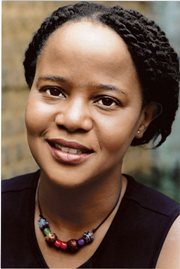
 Edwidge Danticat, famous Haitian-American author, sees the stress of crisis as a force for artistic creation, and sees the role of the immigrant artist in the documentation of events.
Speaking recently at Town Hall in support of her new book, Create Dangerously: The Immigrant Artist at Work, Danticat explored the theme of being an artist from a place seemingly forever reacting to calamities, repression and grief. In her view, without art and creation, humanity draws a veil of amnesia over unhappy events. As an immigrant writer, and a member of the Haitian Diaspora, she feels the power of events in her homeland through the lives of family, friends, and powerful stories central to her sense of Haitian culture.
 Danticat recounted examples of artists inspired by Haiti’s recent catastrophic earthquake. Some were stunned by the event and found they were unable to create in the moment, but for others, the crisis was the catalyst. She spoke movingly as she recalled an artist who defied tsunami warnings directly after the earthquake to paint at the beach as an outlet for his reaction to the chaos and destruction. The emotions of the moment stirred his need to create, a syndrome that Danticat mentions in relation to Albert Camus, the French writer and philosopher, whom she quotes on the subject. The title, “Dangerous Moments” is from a lecture by Camus of the same name that you can read in his collection Resistance, Rebellion, and Death.
The history of artistic creation contains many such “dangerous moments,” she noted, and many artists have stories (she calls them creation myths) that both move and haunt them. Her personal powerful and horrific myth is a brutal execution, more than forty years ago, of two Haitian patriots returning to their island to fight against the repressive regime of ‘Papa Doc’ Duvalier. Danticat wasn’t there, but has lived with the tale all her life and has explored within it the themes of life and death, homeland and exile, grief, and moral rebellion against higher authority, all found in the event. These thoughts have motivated her work. She explained that a dangerous moment may not only spark the creation of a work, but could continue on as being dangerous for those under the rule of a dictatorship who read or speak about an event. The danger is transferrable. Her book is a collection of personal stories told at a level that interacts with her philosophic point of view, that creation can be a human reaction to crisis.
~Carl K., Central Library
Leave a Comment