
 Editor’s note: We are thrilled to have Adam Johnson here today talking about books about North Korea and one of his research trips for his novel The Orphan Master’s Son.
I must admit that I’m a huge fan of The Seattle Public Library—its yellow tubes and downhill stacks, the way rain sheets off the glass pyramid—it’s a lovely place to research and read and write. So I’m honored to be a guest blogger, and since this post will have a North Korean theme, I want to share my visit to a lending library that’s the exact opposite of Seattle’s: The Grand People’s Study House in the Democratic People’s Republic of Korea.
But, my first duty as guest blogger is to recommend a great book, and while there are many amazing places to start reading about North Korea—like Kang Chol-hwan’s The Aquariums of Pyongyang and Bradley K. Martin’s Under the Loving Care of the Fatherly Leader—I’m going to suggest Barbara Demick’s Nothing to Envy: Ordinary Lives in North Korea, which is simply a must-read. Her reporting on North Korea for the LA Times was something I valued a great deal while writing my novel, which is set in the DPRK. By following the lives of six North Koreans over the course of 15 years, Demick has pieced together, through exhaustive interview and research, the most accurate nonfiction survey of the living conditions in that elusive country. By focusing on real people, rather than politics, she captures the hopes, dreams and fears that finally led her subjects to risk everything by defecting.
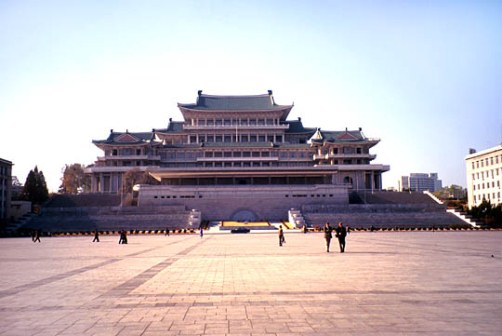
I visited Pyongyang in 2007 on a research trip, so I was eager to visit The Grand People’s Study House, which sits atop Namsan Hill in the Central District and boasts 30 million volumes. A statue of Kim Il-sung, seated in marble like Abraham Lincoln, dominates the entrance, and grand paintings of Kim Jong-il adorn the long halls. One striking painting depicts Kim Jong-suk, the Dear Leader’s mother, dressed in a snowsuit as she shoots Japanese soldiers in the snowy woods. Very sexy! But I couldn’t mention that to our minders. The library was built to celebrate Kim Il-sung’s 70th birthday, and the quiet rooms and empty halls echo with a funereal feel. I was struck by how much the building felt like Kumsusan Memorial Palace, where Kim Il-sung’s body lies in state. Perhaps I’m describing the interior so much because no books were visible in The Grand People’s Study House.

- Conveyor belt delivery of a requested book.

At the front desk, I asked through an interpreter to see a book. The librarian nodded, and soon, via a little conveyor belt transporting system that wasn’t dissimilar to a model train, a book made its way to us. It was a user’s manual for Windows 95. One member of our group had visited the Study House ten years earlier, and he remarked that he had been shown the same book. The librarian assured us that she had books by Moliere, Tolstoy and Shakespeare, but that these were in a special collection unavailable to us. I expressed amazement that The Grand People’s Study House could hold 30 million books. The librarian then beamed with pride when I admitted that the library where I taught at Stanford University housed a mere 9 million volumes. “Such is the reality of a capitalist library,” she told me. Then she took back my copy of Windows 95 and sent it away on its little train. One rule always proved true: in North Korea, there was no such thing as irony.
~ Adam Johnson
The Orphan Master’s Son: A Novel of North Korea is getting terrific reviews at every turn. The story follows Pak Jun Do, whose father runs a work camp for orphans, as he rises through the military ranks until he’s set to challenge Kim Jong-Il. Adam Johnson will read from his newest novel on Monday, January 16, at 7 p.m. at Elliott Bay Books. You can listen to a story from NPR’s Weekend Edition about the novel here.
Leave a Comment