
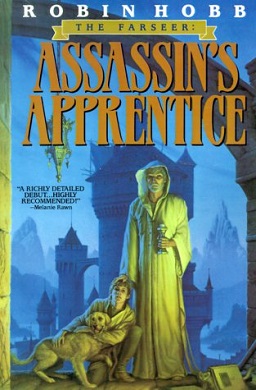
 I love fantasy with detailed world-building, complex characters and political intrigue, so I was pleased to come across Robin Hobb’s Assassin’s Apprentice the first book in the Farseer trilogy.
Assassin’s Apprentice starts when a six year old child, only known even to himself as “boy,” is dropped at the royal court by his grandfather. The boy, later dubbed Fitz, is the bastard of Prince Chivalry, and the fact of his existence is all the more an affront in the face of Chivalry’s lack of an heir with Lady Patience. Fitz grows up at the heels of Chivalry’s stableman, Burrich, and it is in the stables that he learns he easily bonds and connects with the minds of animals, a skill called Wit which Burrich makes Fitz known is to be feared rather than indulged. When King Shrewd takes an interest in Fitz, he begins his training as an officially acknowledged offshoot of the royal bloodline. Fitz’s training includes secret sessions with the King’s man, Chade, where he learns the subtle arts of death.
Fitz is a character that is apart from his surroundings, never fully trusted and accepted, and this in-between status shapes him in interesting ways.
 Robin Hobb creates a rich, complex world and introduces the stories, myths and superstitions that define the Six Duchies at the beginning of each chapter. Assassin’s Apprentice explores loyalty, survival and ethical dilemmas within a story packed with psychological growth and surprising political schemes resulting in a breathless, dark conclusion.
Hobb’s debut certainly earned her a following that has only grown over the course of her career. If you enjoy the Farseer trilogy, you can follow Fitz in the Tawny Man trilogy as well.
Also, check out Robin Hobb’s recent interview with Peter Orullian.
Leave a Comment