
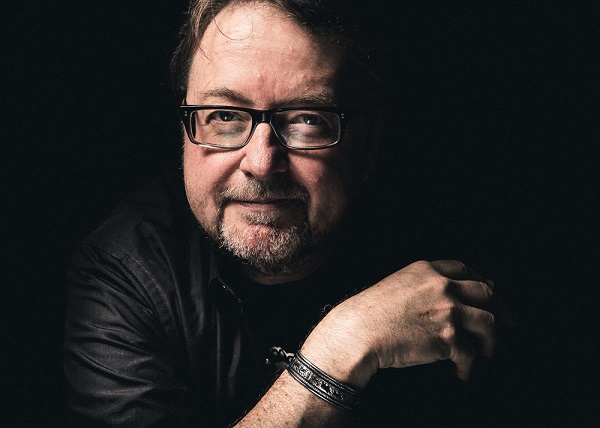
 Do you have your free ticket to Seattle Reads yet? On Oct. 19-20, renowned Mexican-American author Luis Alberto Urrea will visit Seattle to share his bestselling novel “The House of Broken Angels.”
Urrea, who has been described as a “master storyteller with a rock and roll heart,” will appear at El Centro de la Raza’s Centilia Cultural Center at an event in Spanish (Oct. 19, 7 to 8 p.m.); the Library’s Lake City Branch (Oct. 20, 1 to 2 p.m.); and the Central Library’s Level 1 Microsoft Auditorium (Oct. 20, 7 to 8:30 p.m.). These will be the first in-person events for Seattle Reads, the Library’s citywide book group, in three years. Find all details and registration links at www.spl.org/SeattleReads.
Urrea was kind enough to preview his talk in this Q&A. (Many thanks to Collection Services manager Elena Gutierrez and The Seattle Public Library Foundation board president Justo González for their help in developing these questions.)
 “The House of Broken Angels” is about the De La Cruz family and its dying patriarch Big Angel, who buries his mother and celebrates his last birthday in an epic family gathering. Although published before COVID, it deals with COVID-era themes such as loss, grief and regret, with plenty of humanity and humor. Have readers made this connection?
Absolutely. In fact, I would say this is the predominant theme when people contact me. They want to laugh or cry about family, especially those who are gone. I think COVID sharpened those emotions for a lot of readers.
What has surprised or intrigued you about readers’ responses to “The House of Broken Angels”? Have they changed since the book was published in 2018?
Actually, yes the responses have changed since the book was published. I remember a public appearance that startled me when people complained about the Mexicanness of the story. My favorite quote: “The Mexicans in your book speak too much Spanish.” Now it strikes me as hilarious — that short-sightedness — because, of course, this book isn’t about “Mexicans” but about human beings who happen to be Mexican. Like all immigrants to this country, they are actually Americans with a certain music of their own. The older the book has gotten, and the younger the readers have gotten, the more the message of shared humanity has found traction.

You’ve said that “The House of Broken Angels” was inspired by events in your own life. Did writing it help you process grief? What epiphanies did you have as a result of writing this novel?
In spite of the novel’s wild comedy, it plunged me into a cleansing grief. It taught me how to mourn my brother, rather than simply feel numb and displaced by yet another Urrea death. The epiphany for me was about the true nature of love and the true nature of family. Readers have told me over and over that this was an Irish novel, a Scottish novel, an Italian novel, an African-American novel, an Asian novel and so on. I did not know that the specificity of my own need to tell about my own culture would find grace notes in every culture.
“The House of Broken Angels” was published during a time of particularly intense division for our country. How do we create space for empathy and love to crowd out fear and division?
You, in your love, must be stronger, braver and fiercer that the puny idiots who live by hatred and division. Do not cower, step forward. There was an old quote of mine that someone made into a beautiful meme (without any input from me): “Saying I love you to each other is the entire point. Fill your pen with love or don’t bother picking it up.” You can create a space for paranoia and hatred. Or you can create a space for your hope and your belief and do it by art. You already know what that space looks like: It is an aspen grove, it is an Alaskan mountain range, and every path is lit with signal fires.
You’ve often written about the border and its effect on people’s journeys. You’ve also referred to the border as a metaphor, a kind of liminal space. How does the border as a liminal space interact with your writing?
Step on a subway. Tell me what person can you rush to, sit beside, lean against, put your head on their shoulder? You need to see that the border is EVERYWHERE. You need to stand on stage beside me and see it weaving through the audience. You need to go to the classrooms at any university or school and see that automatically white students gather in one corner, black students in another, young Muslim women in hijabs not attended by either group. The Latinx students come hang with me. What do I do? My job is to remind you that you are a human being and you can actually put some of your prejudice and fear over in that corner and try something new. Try thinking, just once, that “I am one of you and you are one of us.” There is no them, there is only us.
You’ve said you consider yourself a mystical writer. What role does storytelling in the Mexican/Spanish tradition play in “The House of Broken Angels”?
Well, you have to understand that although it is fiction, it is inspired by the same people swimming in my personal gene pool. We were raised by the same healers, seers, crackpots, occultists, and straight up liars, jokers, boasters and dreamers. We share the same blood and genes as Teresita aka “The Hummingbird’s Daughter.” I was raised with tales of hauntings, apparitions of ghosts, insane tall tales that enthralled all of us kids, horrifying heartbreaks, inexplicable wonders. You know, García Marquez didn’t think his work was all that fanciful. One thing you may not know about the Mexican side of my family is that they are also Irish and also Basque and some historians have traced us back to the Visigoths. What kind of stew is that? Now, let us mix in my mother’s British roots. If we don’t see, if not a mysticism, a certain narrative flow, we’re not looking carefully enough.
Finally, what have you been reading lately?
Lately, I have been trying to earn my blessings by being of service. It was perhaps suicidal to chair the National Book Award in fiction last year and I am on several judging panels this year as well. The one I am most excited about is the inaugural Ursula Le Guin Literary Award but I am also trying to pay back dues to writers who have meant something to me. So I have re-read copious amounts of Rudolfo Anaya and Jim Harrison. I also read lots of poetry, I read truckloads of haiku, I comfort myself with Mary Oliver, I never veer far from William Stafford and you can’t ever find me without a rockin’ mystery book under my arm.
Details on Seattle Reads events
Urrea will appear at three Library events:
- Wednesday, Oct. 19 from 7 to 8 p.m. at el Centro De la Raza’s Centilia Cultural Center, 1660 South Roberto Maestas Festival St., Seattle. This program will be offered in Spanish. Este programa será ofrecido en español.
- Thursday, Oct. 20, from 1 to 2 p.m. at The Seattle Public Library’s Lake City Branch, 12501 28th Ave. N.E., Seattle
- Thursday, Oct. 20, from 7 to 8:30 p.m. at The Seattle Public Library’s Central Library Level 1 Microsoft Auditorium, 1000 Fourth Ave., Seattle
Find a copy of “The House of Broken Angels”
Copies of the book are available in the Library’s catalog in both English and Spanish. Limited copies will also be available for informal borrowing (meaning you don’t need to check out the copies) at most Library locations in English and Spanish.
Seattle Reads is presented in partnership with La Sala, El Centro de la Raza and Seattle Escribe, and is made possible by The Seattle Public Library Foundation and The Wallace Foundation. Additional support provided by media sponsor The Seattle Times and Back Bay Books.
For more information, visit www.spl.org/seattlereads, call the Library at 206-386-4636 or Ask Us.
– Elisa M., Communications
Leave a Comment