
It’s getting darker, folks. Sad about shorter days? Why not fill your longer nights with movies! Once we truly inhabit Seattle’s usual noir state…tumbling into the unrelenting dark, opting against navigating rain-slicked streets, and becoming actually as well as metaphorically more internal, it becomes time to embrace rather than turn away from the darkness without (and within) with the wonderful/horrible world of film noir, seen by many as America’s most significant artistic contribution to movies.
Beloved by those who plainly emulate it (Jean Luc Godard, The Coen Bros, David Lynch, Christopher Nolan, etc.) and those who just love it (SIFF, Noir Czar Eddie Muller & his Film Noir Foundation, this librarian, etc.), film noir is a movement from roughly 1941-1959, the culmination of French Poetic Realism, German Expressionism, American pulp novels, crime photography, the Ashcan School of painting, and generally reflective of war and post-war disillusionment. Named in sum by the French after they reduced war-time tariffs and lifted quotas, it directly inspired the French New Wave and so much since then. We’re going to steer clear of the classics in favor of film noir’s more obscure, darker corners, if you will. No need to once again take Sunset Blvd to pick up The Maltese Falcon before ending up in The Big Sleep.
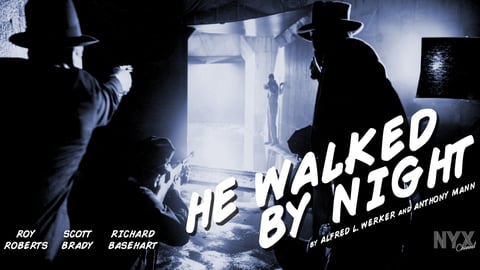
 Based on a true story, 1948’s He Walked by Night is the police procedural noir that inspired the TV hit Dragnet!* Dead of night, Los Angeles, a cop is gunned down in the first few minutes of the film. We follow a couple sergeants through police stations, learning how they craft an investigation, the gritty details of their work eventually taking us to an electronics dealer selling a stolen projector, which allows them to reconstruct the killer’s face. Though the story ripped from the headlines is hi-tech stuff for 1948, the gorgeous chiaroscuro by John Alton, the cinematographer who wrote the book on the subject**, is the reason to see this gorgeous piece of celluloid. Stream He Walked by Night right now on Kanopy!
 Jumping ahead 10 years, is The Sound of Music director Robert Wise’s brilliant, prescient, proto-arthouse film noir Odds Against Tomorrow. Racist ex-con (noir stalwart Robert Ryan) and aggrieved nightclub performer Johnny Ingram (the great Black singer and activist Harry Belafonte), looking for a score, are drawn by a crooked ex-cop into one final job*** with typically noir-disastrous results for our beloved anti-heroes. Tackling issues of class and race in a quick, modern style, Odds Against Tomorrow also features the stunning & storied Gloria Grahame.
Alone or together, you can enjoy how kind and decent in comparison our world seems when you emerge from les mondes noir. It may just send that seasonal depression skittering off to its own dark corner. Bonus: since these films were all made during the production code era (1934-1968, when Hollywood censored its own films to avoid harsher penalties from elsewhere), they are uniformly safe family watches.
Postscript: did you know that most of these films are adapted from terrific romans noir (noir fiction) from the likes of Raymond Chandler and Cornell Woolrich? More on that another time!
Post-postscript: the Seattle International Film Festival hosts two separate film noir series! Late Sept through Late November: Dark Dreams: The Original Film Noir Series at SIFF Cinema Egyptian Theater. Earlier this year, it was Noir Czar Eddie Muller’s Noir City. The Seattle Public Library carries many of the films featured (and an astonishing 229 noir titles by subject heading alone!), but I’d be remiss not to highlight Criss Cross (another great heist picture) and In a Lonely Place, both masterpieces. If you missed them at the festival , you can enjoy them in the true comfort of your own home, especially as compared to the hell-scape of noir.
*While we don’t carry Alton’s seminal Painting with Light, we do carry another fourteen of his films. Study the master by viewing the best-looking photography noir has to offer in films like the highly-recommended The Big Combo (1955) and Amazing Mr. X (1949).
**For those who are too young to have seen this cultural phenomenon of the Fifties & Sixties even in reruns, it’s where the phrase “just the facts, ma’am” comes from.
***A noir trope…see also Stanley Kubrick’s The Killing, Robert Siodmak’s The Killers, Jules Dassin’s Rififi, and John Huston’s The Asphalt Jungle; all top notch!
~ posted by Alan J.
Leave a Comment