
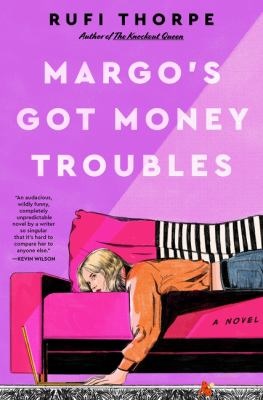
“Margo’s Got Money Troubles” by Rufi Thorpe proves that other people’s problems can be pretty funny — as long as they’re narrated by a chaotic heroine who is wisecracking and whip-smart.
Nineteen-year-old Margo Millet was not exactly set up for success with a flighty mother and an absentee, former wrestling star father. But when Margo sleeps with her community college English professor and winds up pregnant, her life path slides way off course. Margo needs to make a major pivot to support herself and her son, Bodhi, so she leaps into the wild, weird world of OnlyFans. Things get even more interesting when her newly divorced father, Jinx, shows up after leaving rehab and the wrestling circuit.
What starts as a train wreck becomes a tender exploration of love and support, as well as a feminist empowerment narrative in which a young woman finds her voice and ditches respectability politics. Or, as Margo sums it up, “Margo could see it both ways: hometown girl makes good, defies capitalist patriarchy, or teen whore sells nudes while nursing, too lazy to work.”

Gig Harbor author Matt Dinniman’s previously self-published series was picked up by a major publisher, Ace, due to its popularity and fan base, and you can see what all the fuss is about with the first in the series, “Dungeon Crawler Carl.”
Coast Guard vet Carl runs outside on a cold Seattle night in boxers and his ex-girlfriend’s too-small pink Crocs to find her show cat, Princess Donut the Queen Anne Chonk, who has jumped out the window. He finds Princess Donut and a big surprise: all the buildings around them — and, as it turns out, around the world — collapse. They learn from an otherworldly broadcast that aliens have destroyed civilization, and they are among the few remaining survivors. They can choose to attempt survival on Earth’s ravaged surface, or enter “the Dungeon,” a dangerous televised game show that is designed for intergalactic entertainment where survival is not assured. If humanity wants to live another day, they need to play to win.
Gonzo humor and action abound in this gamified post-apocalyptic story where Carl fights bosses and toxic slime barefoot (yes, he loses the Crocs!) alongside the now talking, sassy Princess Donut who aspires to viral intergalactic stardom. You don’t have to be a role-playing game fan to enjoy this romp!

In “Everybody’s Favorite: Tales From the World’s Worst Perfectionist,” comic writer Lillian Stone has taken the awkward stuff of growing up in the Ozarks in the early 2000s and spun the sticky details into comedy gold. Stone describes trying and failing at being a people-pleasing perfectionist, reminisces about pursuing every fashion fad, no matter how unflattering, and examines, with frank tenderness, the many pratfalls of her younger years, in which she plunged “into a lifetime of deep, sweaty self-hatred.”
Riddled with funny family stories, rich depictions of pop culture and beauty products, Stone shows off her comedy writing aplomb by mining wince-worthy and squeamish memories. These are, after all, what paved the way to embracing her kooky self with gusto. Warning: snort-laughing on mass transit may ensue as you read about her family’s penchant for fart jokes, navigating sexual awakening as a confused Evangelical teen and the high jinks of high-maintenance dogs.

“I try to take what’s dark about the world and shake out the satirical and the silly.” If you like David Sedaris, you are sure to enjoy “Here for It: Or, How to Save Your Soul in America” by R. Eric Thomas. In delightfully cheeky, sometimes sweet essays about growing up Black, gay and Christian, Thomas shares how he is now paid to write pithy, frothy things on the internet.
Before he went viral for a 2016 post about President Barack Obama, Canadian Prime Minister Justin Trudeau and Mexican President Enrique Peña Nieto looking like “the new interracial male cast of Sex and the City,” Thomas attended a private high school in Baltimore and an Ivy League college. He quips how his upbringing, growing up in a derelict city but affording a private education by hardworking parents, contributed to becoming obsessed with Mr. Rogers and Whitney Houston and set him on the unlikely path of online opinion generation. Thomas proclaims, in a particularly hilarious rant, that if there is any justice in this world, Lady Elaine Fairchilde, the Karen-esque puppet foil to Mr. Rogers’ buoyant optimism, should be a gay icon. “Why is there not a Lady Elaine float at every Pride?”
Through brilliantly constructed pop culture memories, tender family scenes and coming-of-age ruminations, this memoir pops and fizzes with hilarity and heart.
Leave a Comment