
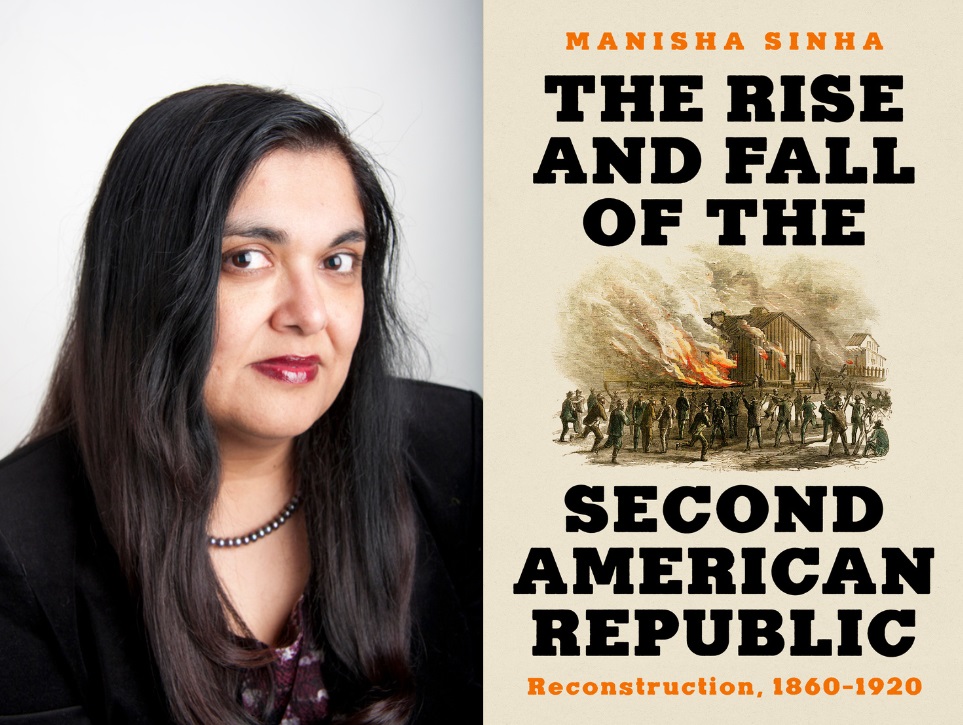
On Thursday, Dec. 5, award-winning historian Dr. Manisha Sinha will come to the Central Library to give The Seattle Public Library’s annual Bullitt Lecture in American History, based on her book “The Rise and the Fall of the Second American Republic.”
In her book, Sinha argues that the post-Civil War period of Reconstruction – what she calls the “Second American Republic” – was far more than a fleeting experiment with interracial democracy. In fact, she says, the lessons of Reconstruction couldn’t be more relevant today, serving as a reminder of how young and fragile our democracy truly is.
Below is a Q&A with Dr. Sinha that previews her talk. Don’t miss her in person on Dec. 5 – find out more and register on the SPL events calendar (www.spl.org/Calendar).
SPL: How did you end up pursuing history as a career?
Dr. Sinha: I grew up in India in a family of historians. My father joined the British Indian Army as an officer during the Second World War and my mother was a Gandhian in the nationalist movement. History was the stuff of conversation around the dinner table every night. They would always have these interesting debates about modern Indian history. Even though my father was not an academic or a professional historian, he had a master’s in history, wrote history books and told tremendous stories. My middle sister and I both became historians.
SPL: Your previous book was a history of the abolitionist movement, which won the Frederick Douglass Book Prize. What drew you to write about Reconstruction next?
Dr. Sinha: I think Reconstruction is never taught properly in United States history. It’s typically described as this brief period after the Civil War when the country experiments with interracial democracy and Black citizenship in the South. Most historians look at Reconstruction as starting in 1865 and going up to 1877. But I extend that period well beyond 1877, because many of the Reconstruction laws and the amendments and the achievements are not completely undone until the 1890s when Southern states rewrite their state constitutions, formally disfranchising Black men, who had gotten the right to vote with the 15th Amendment to the Constitution.
The story of Reconstruction is the story of the tremendous achievements of American democracy, the fact that formerly enslaved people got these political rights and were elected to office at the state and national level. And then suddenly, all that is overthrown. How does that happen? My students always ask me that, and I wanted to tell that larger story of the undoing of Reconstruction.
SPL: You connect movements such as the fight for women’s suffrage to Reconstruction – can you tell us more about that?
Dr. Sinha: I argue that the struggle for women’s suffrage began in Reconstruction, and that the 19th Amendment, which gave women the right to vote in 1920, is really the last Reconstruction amendment. It all occurs, however, under the shadow of the defeat of Reconstruction. Because when you get the 19th Amendment, of course, Black women in the South remain disfranchised until the Voting Rights Act of 1965.
I also include the history of labor and of immigrants and the story of Chinese exclusion in the 1880s because all of these strands are connected to the demise of Reconstruction, when the defeat of Black freedom becomes the defeat of American democracy.
SPL: Anything else you’d like to share?
Dr. Sinha: You can’t understand the legacies or the significance of Reconstruction if you don’t understand how it was systematically overturned. That included domestic racist violence and terrorism in the South, and it also included a very reactionary Supreme Court. The Supreme Court gave the green light to the South to disfranchise Black men. It gave the green light to the South to have Jim Crow, so they never really implemented the 14th and the 15th amendments, and I would say even the 13th amendment.
If you look at U.S. history, it’s not just the story of constant progress, but on the other hand, it’s also not a story just of racism and reaction. It has always involved a contest between the two. We can really see how our present moment is informed by this history.
SPL: What books have you recently read that have had an impact?
Dr. Sinha: I grew up reading fiction and loving fiction, but the two books that that come to mind immediately are nonfiction. There is a book by Kathleen DuVal called “Native Nations.” She is telling a story that that most U.S. historians don’t pay any attention to, which is the history of North America before colonialism. It’s a great read.
And I also just read a book by Tomiko Brown-Nagin called “Civil Rights Queen,” about Constance Baker Motley, a Black woman born in Connecticut. It’s a great biography about a woman who pioneered some of the civil rights tactics that were used by the NAACP and Thurgood Marshall. She’s a forgotten figure and she was a pioneer.
Dr. Manisha Sinha will present the Bullitt Lecture in American History on Thursday, Dec. 5, from 7 p.m. to 8:30 p.m., at the Central Library. Register here. Thanks to our sponsors The Seattle Public Library Foundation, Elliott Bay Book Company and the Gary and Connie Kunis Foundation.
Dr. Manisha Sinha is the Draper Chair in American History at the University of Connecticut. Her book, “The Slave’s Cause: A History of Abolition,” won the Frederick Douglass Book Prize among several others and was long listed for the National Book Award for Non-Fiction. Her most recent book is “The Rise and Fall of the Second American Republic, 1860-1920.”
Leave a Comment