
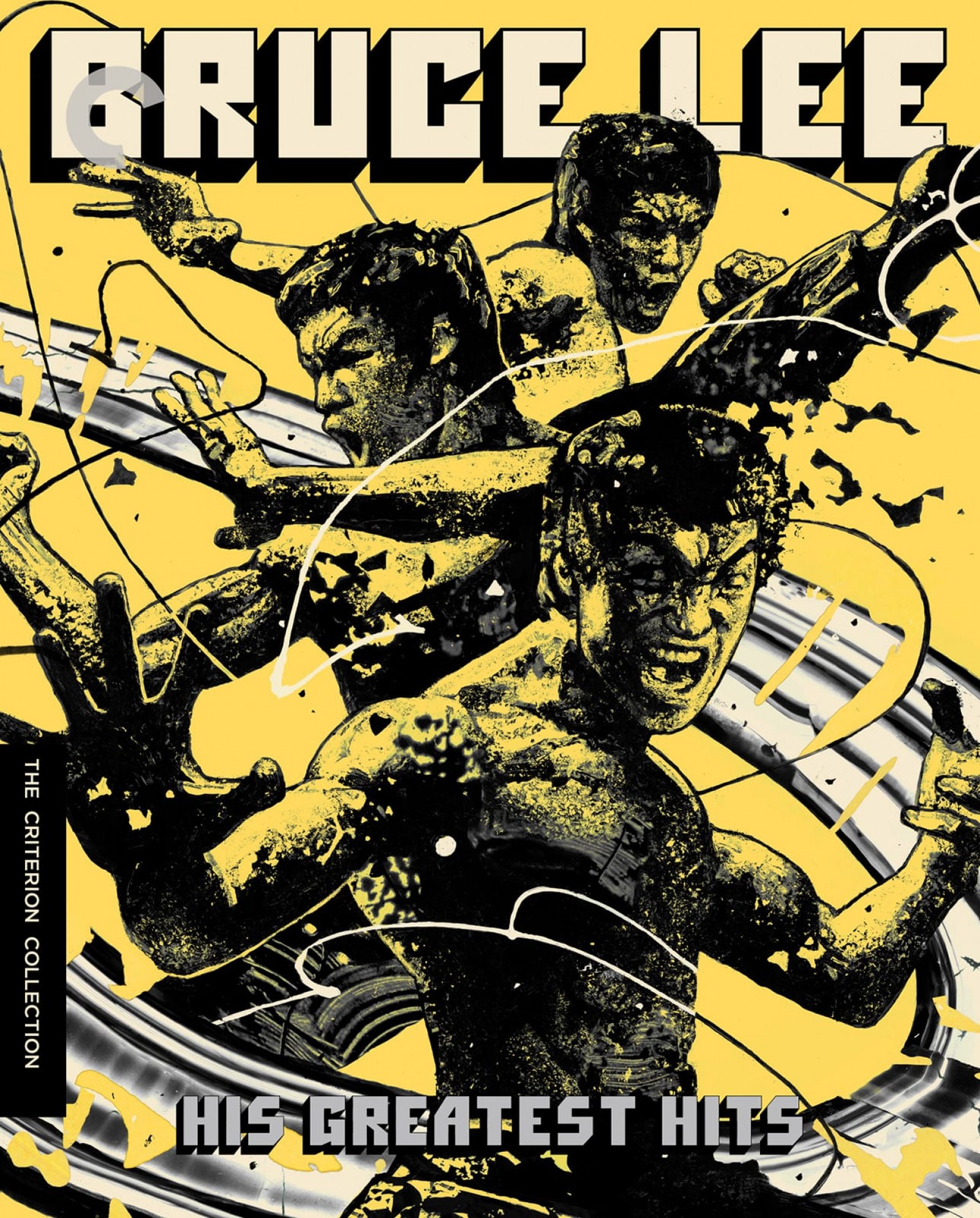
Did you know we recently added Blu-Rays? And that compared even to streaming HD, Blu-Ray offers better stability (vs. Wi-Fi), picture, and audio (especially when considering beautifully curated prints)? Enter Bruce Lee! Where legends collide, your library’s box set, Bruce Lee: His Greatest Hits contains seven painstakingly restored Blu-Rays featuring most of the local legend’s best work. Released by Criterion in 2020, this set holds up to their renowned curation and restoration standards.
This is a great set for both fans and those new to Bruce Lee. For the latter, Lee was born to a Chinese opera star father in 1940 San Francisco, raised in Hong Kong where he appeared in most of his 24 movies and learned kung fu, moved to Seattle in 1959 to help family friends at Ruby Chow’s Restaurant and finish high school, then studied drama, psychology, and philosophy at the University of Washington. Lee dropped out and opened kung fu academies in Seattle, Oakland, then LA. In 1966, he became The Green Hornet’s sidekick, Kato, on the cult classic TV series, the first exposure to martial arts (something Bruce Lee insisted on) for most Americans. While there, he met and trained actors like Steve McQueen and James Coburn. Bit parts, fight choreography, and sorta having the idea for TV show Kung Fun stolen all convinced Lee to return to Hong Kong to make films.
The set opens with Lee searching for his voice in 1971’s The Big Boss, amid corny set pieces imposed by the director. Jeff Chang’s accompanying essay describes it as more “Wile E. Coyote” than “Bruce Lee” when Lee thrusts an opponent through a barn wall, which leaves his silhouette. Excellent fight scenes, choreographed by Lee himself, set him apart with his revolutionary blend of street fighting and kung fu. The almost coincidental heroin smuggling ring story is a fun watch, significant because you can put yourself in the place of a viewer of the time and feel the electric charisma and physicality that instantly turned Lee into a huge star.
Fist of Fury (1972) is notable as Lee’s sole period piece, set in 1930s colonial Shanghai. When Lee discovers his master has been murdered, he goes on a rampage against the Japanese dojo responsible. Magnetic appeal and kinetic fighting style are brilliantly choreographed by Lee, as he harkens back to Japanese film, and looks forward to mixed martial arts. Some see Lee as the godfather to today’s popular MMA scene; his fighting style is a blend of kung fu, karate, judo, tai chi, boxing, Filipino style Escrima with its nunchuck weaponry, and tons more.
On the heels of two huge hits, Lee hoped Way of the Dragon (1972) would be his ticket back to Hollywood. Brought to Rome to protect a Chinese restaurant (in the form of love interest Nora Miao) from the mafia, he described his character thus: “Well, it is really a simple plot of a country boy going to place where he cannot speak the language but somehow he comes out on top, because he honestly and simply expresses himself by beating the hell out of everybody who gets in his way.” Much of the film’s appeal is a nine-minute fight with the mafia’s hired and imported gun, played by Lee’s student Chuck Norris in his film debut. Another reason many consider this among his best films is Lee’s creative control: as writer and director, he shows comedic chops, charms, and amuses.
Often considered the best martial arts film ever made, smash hit of 1973 Enter the Dragon is Lee’s only Hollywood film and his most fully realized. Sadly released six days after he died from a reaction to painkillers, this film bursts at the seams, from the Lalo Schifrin score to the James Bondian plot (he’s sent undercover to infiltrate a martial arts tournament) to Lee’s incredible fight choreography along with James Minton Kelly and John Saxon who help him take on a criminal empire! There is so much here that it sparked a culturally pervasive martial arts fad, showing itself everywhere, even in disco!
Lee died before finishing Game of Death, released five years after his death, in 1978. Footage of many old Lee films plus, incredibly, his actual funeral is spliced into the surreal film. The iconic fight with Lee’s student Kareem Abdul-Jabbar is remarkable, and what Lee aspired to do- fight a different style of opponent on every floor of a tall building- was influential on story structure of many future martial arts films. While this is widely considered his worst film, there is a lot of good stuff in it, making it another enjoyable watch. More importantly, though, Lee’s legacy is reclaimed through this dazzling set, including two discs of interviews, alternate versions, and a variety of goodies reflecting & amplifying our local legend’s immortality.
~ posted by Alan J.
Leave a Comment